Starting a business is rarely tidy. You may pay for ads before your first sale, buy tools before your first customer, take a training course before your first appointment, or order supplies before your shop opens.
If you are a sole proprietor, freelancer, gig worker, driver, hairdresser, barber, cleaner, seller, creator, consultant, or side hustler, the tax question is not just "Did I spend money?" It is also "Did this happen before the business started, after it started, or for something that needs separate review?"
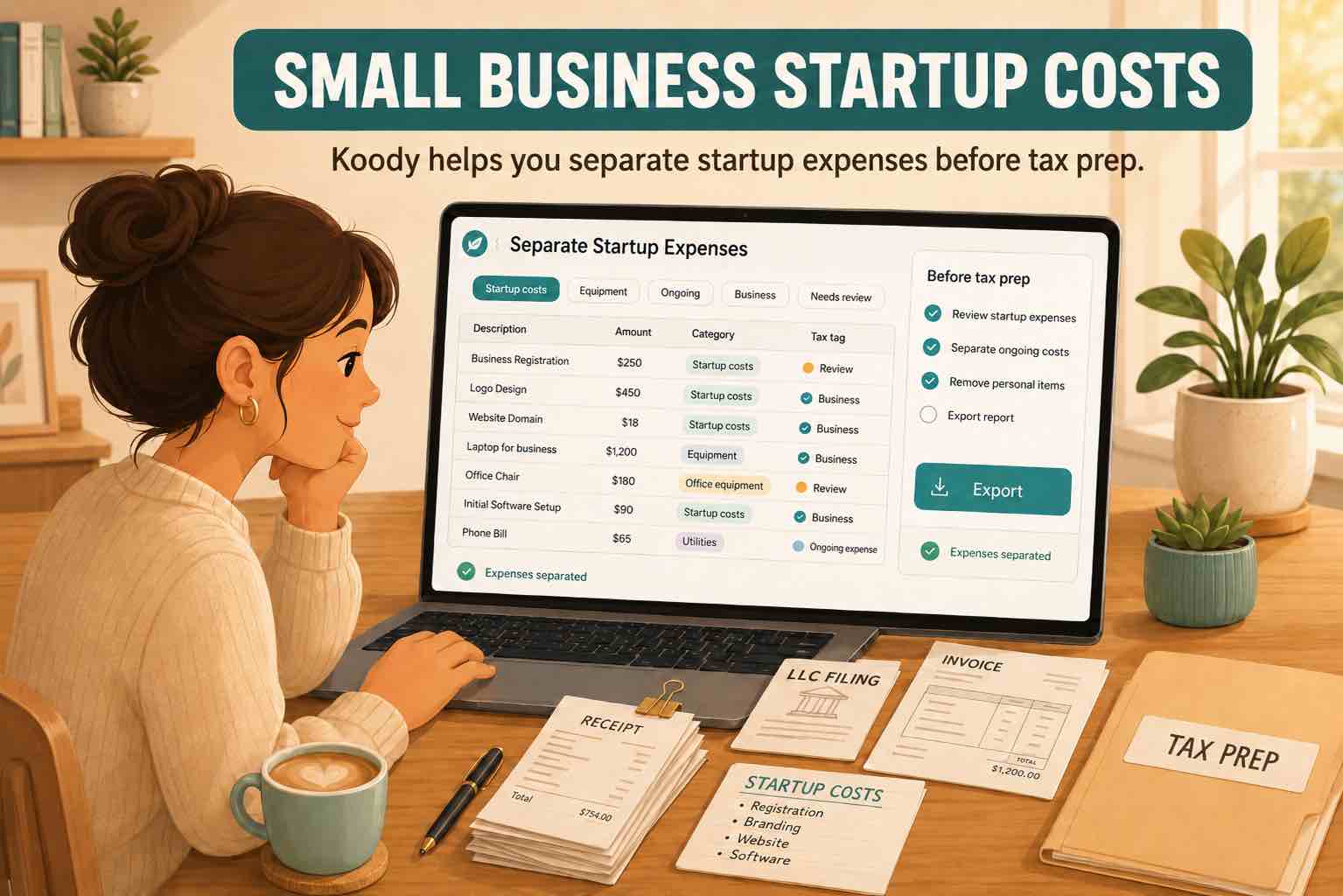
This guide explains the IRS startup cost idea in plain English, then shows what to separate in Koody before tax season.
Important: Koody is a budgeting and record-prep app, not a tax filing service, tax advisor, accountant, tax preparer, depreciation service, amortization service, or law firm. Use Koody to organize transactions, categories, receipts, files, notes, splits, imports, and exports. A qualified tax professional should decide final tax treatment.
What small business startup costs are
What counts as startup costs?
Startup costs are costs you pay before the business actually begins operating. The key is timing: the purchase happened while you were getting ready to open, sell, drive, take clients, or serve customers.
Common startup costs can include:
- Pre-launch advertising.
- Market research or customer research.
- Product research.
- Travel to find suppliers, vendors, or customers.
- Training before you start offering the service.
- Consultant or professional fees for getting the business ready.
- Software, tools, or services used to prepare for launch.
- Licenses, permits, or setup costs that need review.
The important phrase is "before the business actually begins operating." A barber buying supplies before opening a chair, an Etsy seller buying tools before listing products, a therapist paying for practice setup costs before seeing clients, or a rideshare driver paying for setup costs before starting rides may all have records worth separating.
The $5,000 startup cost rule in plain English
Are small business startup costs tax deductible?
The IRS says startup costs are generally capital expenses. That means they are not always treated like regular expenses you deduct right away.
Under the IRS startup cost rule, a business can elect to deduct up to $5,000 of certain startup costs. That $5,000 amount is reduced when total startup costs exceed $50,000. Remaining startup costs may need to be spread out over time through amortization.
In plain English: do not throw every pre-launch purchase into regular expenses and assume it is done. Track the cost clearly, keep the receipt, and let your accountant or tax preparer decide what can be deducted now and what may need to be amortized.
The timing matters too. The remaining costs are generally amortized beginning with the month the business begins. That is why your launch date belongs in your records.
Startup costs vs ordinary business expenses
What is the difference between startup costs and regular business expenses?
Startup costs happen before the business starts operating. Ordinary business expenses happen after the business is already operating.
A purchase can look the same on your bank statement but need different review because of timing:
- Instagram ads before launch may be startup advertising.
- Instagram ads after launch may be regular Marketing & Advertising.
- Training before your first paid client may be part of startup records.
- Training after the business is running may be reviewed as an ordinary business cost.
- Software bought before opening may need a launch-date note.
- Software used every month after opening may be a normal operating cost.
The bank row alone will not explain that timing. A short note can.
Startup costs vs organizational costs
What are organizational costs?
Organizational costs are costs connected to creating a business entity. They are not the same as every cost of starting a business.
Examples may include some legal, accounting, filing, or setup costs tied to forming an LLC, corporation, partnership, or other entity. A sole proprietor who never forms a separate entity may have fewer organizational-cost records, but legal and professional costs should still be tracked clearly.
Keep organizational costs separate from general startup spending. A tax professional can decide whether the $5,000 organizational cost rule applies and how the remaining amount should be handled.
Assets, inventory, and personal purchases
Some pre-launch spending does not belong in the startup-cost pile at all. This is where many new business owners get stuck.
Assets and equipment
Laptops, cameras, salon chairs, tools, furniture, vehicles, machinery, and equipment may be assets. The IRS has separate rules for depreciation, section 179, amortization, and property placed in service.
Do not hide these inside one "startup costs" label. Keep the receipt, date, amount, item description, and business-use note so your accountant can review it.
Inventory and product costs
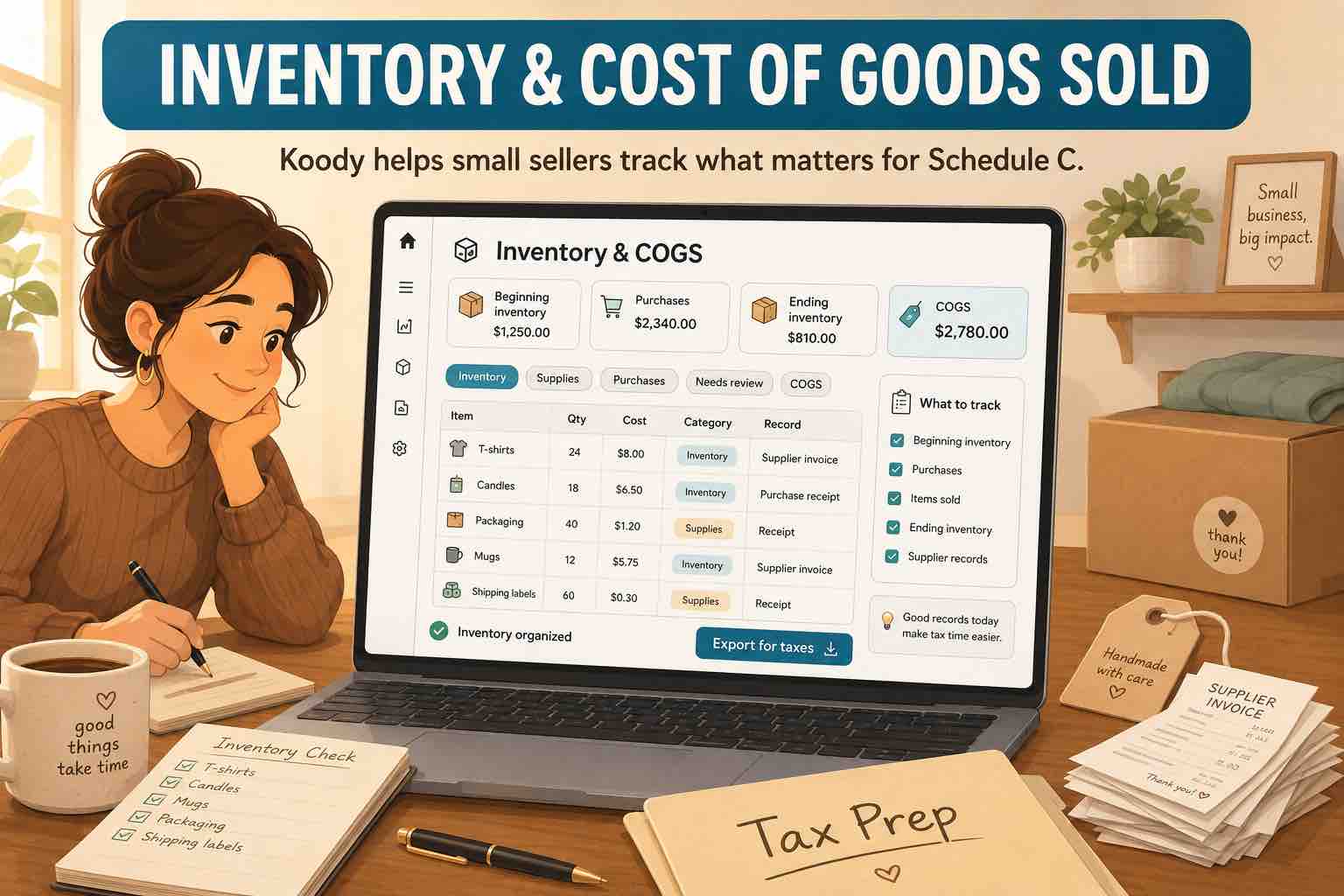
If you make or buy goods to sell, inventory and cost of goods sold need separate attention. Product costs are not always ordinary expenses, and unsold goods may still be inventory at year end.
For example, an Etsy seller buying blank shirts before launch, a baker buying ingredients for orders, or a reseller buying items to flip should separate product costs from general setup costs. For a deeper product-seller guide, read Schedule C inventory and cost of goods sold.
Personal or mixed purchases
A new business often starts in the same bank account as household spending. One Amazon, Target, Costco, or Home Depot charge may include business setup items, household items, inventory, and office supplies.
Koody lets you split one transaction across multiple categories, so the business part can go to startup records and the personal part can stay personal. Add a note when only part of the receipt belongs to the business, so the row is easier to review later.
What records to keep for startup costs
What should I track for small business startup costs?
Keep enough detail for someone to understand what happened without guessing.
- Date: when the money was spent.
- Payee: who you paid.
- Amount: how much you paid.
- Receipt or invoice: what you bought.
- Business purpose: why the purchase was connected to the business.
- Category: advertising, legal, training, travel, software, supplies, inventory, equipment, or another useful bucket.
- Launch-date note: whether the purchase happened before or after the business began operating.
- Asset or inventory note: whether the item may need separate review.
- Split note: whether part of the purchase was personal.
If you are not sure where something belongs, do not force it into a random category. Put the best note you can on the transaction and flag it for review.
Keep startup receipts and notes with the transaction.
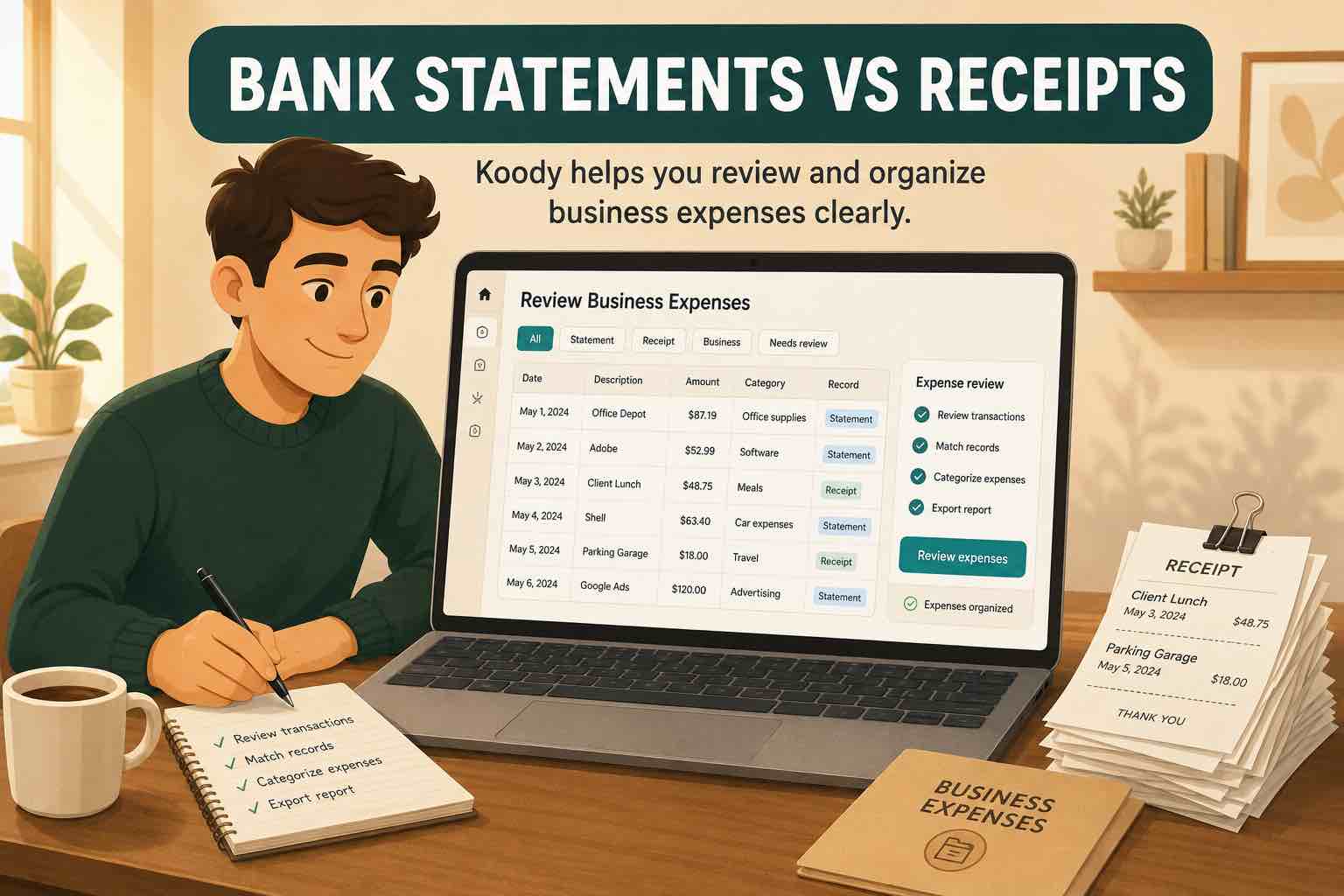
Koody lets you attach receipts, invoices, PDFs, screenshots, and notes to the matching row, so pre-launch spending is easier to review later.
Track startup costs in KoodyHow Koody helps before tax prep
Koody helps you turn scattered startup spending into records that are easier to review.
- Import bank and card transactions when you need to catch up.
- Let Koody auto-categorize rows, then review pre-launch rows carefully.
- Separate Marketing & Advertising, Legal & Professional Services, Taxes & Licenses, Supplies, Office Expense, Business Travel, Inventory / Cost of Goods Sold, Other Business Expenses, Transfers, and Owner Draw / Personal.
- Attach receipts, invoices, PDFs, screenshots, order confirmations, and setup documents.
- Add notes for launch date, business purpose, training, supplier research, customer research, and mixed purchases.
- Split a transaction by category when one receipt includes business setup costs, personal items, inventory, and regular supplies.
- Export filtered records when your accountant, tax preparer, or bookkeeper needs them.
Koody is especially useful when you want to manage household money and sole proprietor records in one app. You can keep personal categories and business categories together without pretending every row is the same kind of spending.
Import, review, attach notes, and export before tax prep.
Bring bank and card transactions into Koody, let Koody auto-categorize them, separate startup costs from ordinary expenses, add launch-date notes, and export cleaner records for review.
Get startup records ready in KoodyWhat to check before tax prep
Before you send startup records to your accountant or tax preparer, review the rows that commonly cause confusion.
- Launch date: when the business actually began operating.
- Pre-launch vs post-launch spending: whether the purchase happened before or after the business opened.
- Assets and equipment: laptops, tools, furniture, cameras, machinery, vehicles, and other longer-lasting items.
- Inventory: products, materials, ingredients, packaging, and goods bought to sell.
- Organizational costs: legal, accounting, filing, and formation costs tied to creating an entity.
- Interest and taxes: costs that may have separate rules.
- Licenses and permits: costs that may need regular expense, amortization, or other review depending on what they are.
- Mixed purchases: one receipt with business setup items and personal items.
- Missing receipts: invoices, emails, screenshots, order confirmations, bank records, and notes that help rebuild the record.
- Abandoned ideas: costs for a business idea that never opened.
If a row is unclear, attach what you have and write a note. A short note written now is better than trying to remember the business purpose months later.
For a broader checklist, read small business recordkeeping for taxes. For general Schedule C buckets, read Schedule C expense categories explained.
FAQs
1. What are small business startup costs?
Small business startup costs are costs paid before the business actually begins operating. They can include pre-launch advertising, market research, training, travel to find suppliers or customers, and professional fees connected to getting the business ready.
2. Are small business startup costs tax deductible?
Some startup costs may be deductible when the business begins, but they may be handled differently than ordinary business expenses. The IRS allows an election to deduct up to $5,000 of certain startup costs, with a phaseout when total startup costs exceed $50,000. Remaining costs may need to be amortized.
3. Can I deduct startup costs before my business opens?
Startup costs are generally costs paid before business operations begin, so they are usually handled when the business starts. Track the costs, receipts, dates, and launch date, then ask a qualified tax professional how they should be treated.
4. What startup costs should I track?
Track pre-launch ads, research, training, software, licenses, professional fees, travel to find suppliers or customers, setup costs, receipts, invoices, and notes that explain what each purchase was for.
5. What is the difference between startup costs and ordinary expenses?
Startup costs happen before the business begins operating. Ordinary business expenses happen after the business is already operating. The same kind of purchase can be reviewed differently depending on when it happened.
6. What are organizational costs?
Organizational costs are costs connected to creating a business entity, such as some legal, accounting, and filing costs. They are not the same as every cost of starting a business.
7. Are laptops, tools, furniture, or equipment startup costs?
Laptops, tools, furniture, machinery, cameras, and equipment may be assets instead of regular startup expenses. Keep them separate with receipts and business-use notes so your accountant or tax preparer can decide whether depreciation, section 179, amortization, or another treatment applies.
8. How does Koody help with startup cost records?
Koody helps you import bank and card transactions, auto-categorize rows, attach receipts and files, add launch-date notes, split mixed purchases, keep personal and business records in one app, and export records for review.
Sources: IRS references used
Sources accessed June 9, 2026. Koody is not a tax filing service or tax advisor.