This guide is for sole proprietors, freelancers, gig workers, independent contractors, hairdressers, barbers, drivers, sellers, creators, consultants, and side hustlers who want better business records before tax prep.
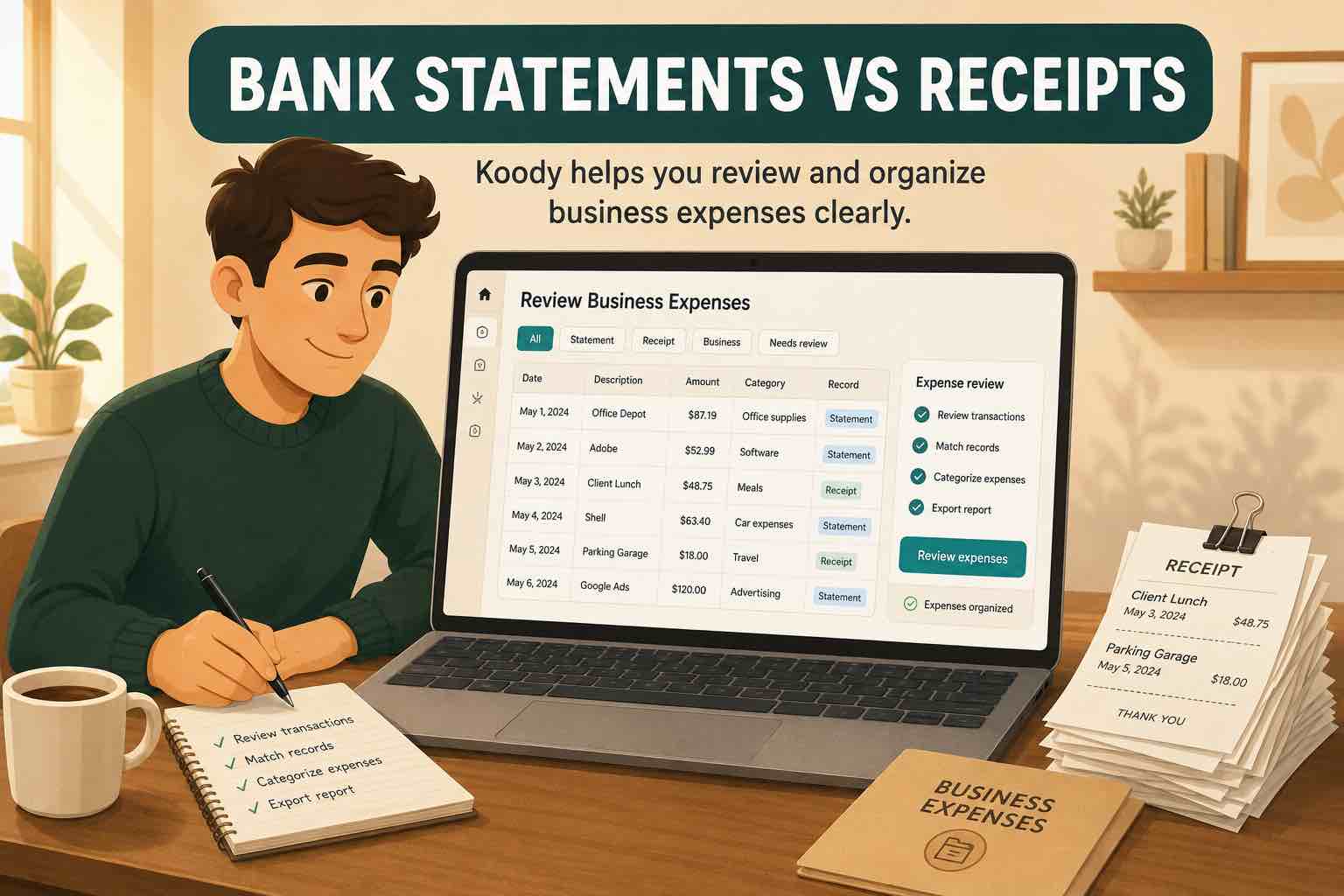
The short answer is simple: bank statements help, but they are usually not a full replacement for receipts. Think of the bank statement as proof that money moved. Think of the receipt or invoice as proof of what the money was for.
Important: Koody is a budgeting and record-prep app, not a tax filing service, tax advisor, accountant, tax preparer, or law firm. Use Koody to organize transactions, categories, receipts, files, notes, splits, and exports. A qualified tax professional should decide final tax treatment.
What a bank statement can prove
A bank or credit card statement is still useful. It can show:
- The date money left your account.
- The amount paid.
- The account or card used.
- The merchant or payee, when the statement gives a clear name.
- Whether money came in, went out, or was refunded.
That is why statements are helpful when you import transaction history into Koody. They give you a starting list of business activity. You can see payments, customer deposits, refunds, fees, card payments, and transfers in one place.
But a starting list is not the same thing as a complete business record.
What a bank statement usually cannot prove
A bank statement usually does not show the details that make an expense easy to review.
For example, a statement might say:
- "Amazon" but not whether you bought printer paper, pet food, or a phone stand for client calls.
- "Costco" but not whether the receipt included office supplies, snacks for home, or packaging materials.
- "Restaurant" but not who attended or why the meal was for business.
- "Gas station" but not whether the trip was for a client, delivery route, school pickup, or personal errand.
- "Target" but not whether the charge was business supplies, household items, or both.
This is where a lot of people get into trouble. They look at the card statement and think, "I remember what that was." Six months later, they do not remember. If the record is reviewed later, the statement alone may not explain enough.
IRS recordkeeping guidance is practical: keep records that clearly show income and expenses, and keep the documents that back up the entries in your books. For many business purchases, the bank statement is one piece of the record, not the whole record.
Keep proof with the transaction.
In Koody, you can attach receipts, invoices, PDFs, screenshots, and notes to the matching row, so the explanation stays next to the charge instead of getting lost in email or your camera roll.
Track proof in KoodyWhat receipts and invoices add
Receipts and invoices usually add the details a statement leaves out:
- What was bought.
- The itemized amount.
- Taxes, tips, shipping, or fees.
- The vendor name and location.
- The order number or invoice number.
- Whether the purchase was one item or many items.
- Whether personal and business items were on the same receipt.
This matters for ordinary business purchases, but it matters even more for broad merchants. Amazon, Walmart, Target, Home Depot, Costco, grocery stores, gas stations, and restaurants can mean many different things. The receipt gives the charge a real story.
A barber buying clippers, a hairdresser buying color, a delivery driver paying tolls, an Etsy seller buying packaging, and a consultant buying software may all have valid business records. But a bank statement alone may not explain those facts clearly.
What to do if you lost a business receipt
Can I still record a business expense if I lost the receipt?
You can still organize the record, but do not pretend the receipt exists. Start with the bank or card statement, then add whatever proof you can find.
Look for:
- An email receipt or order confirmation.
- A PDF invoice.
- A screenshot from the vendor, marketplace, or app.
- A calendar entry showing the meeting, trip, or job.
- A client message, booking confirmation, or project note.
- A written note explaining what you bought and why it was for business.
Write the note as soon as you notice the receipt is missing. Plain language is fine:
- "Printer ink for office documents."
- "Packaging for Etsy orders."
- "Parking for client appointment."
- "Lunch with supplier about spring inventory."
- "Replacement trimmer for barber appointments."
If a tax professional later says the record is not enough, they can tell you how to handle it. Your job in Koody is to make the record honest, findable, and easier to review.
When extra notes matter most
Some purchases need more explanation than others. Add notes when the bank statement does not tell the full story.
Notes are especially useful for:
- Business meals: who was there and why the meal was for business.
- Travel: destination, dates, business reason, and any personal days.
- Car costs: business trip, client visit, delivery route, toll, or parking reason.
- Mixed purchases: which part was personal and which part was business.
- Reimbursements: money paid back by a client, customer, platform, or employer.
- Refunds: what purchase the refund relates to.
- Cash payments: what was paid for, because there may be no bank line.
For meals, travel, and car costs, the category is only the beginning. If those records matter for your business, read Koody's guide to business meals, travel, and car expenses before tax prep.
How Koody helps before tax prep
Koody helps turn bank and card rows into clearer records.
- Import bank and credit card CSVs when you need to catch up.
- Let Koody auto-categorize income, business expenses, transfers, card payments, refunds, and owner draws.
- Attach receipts, invoices, PDFs, screenshots, and files to the matching transaction.
- Add a plain-English note when the merchant name does not explain the business reason.
- Split one charge between personal and business categories when the receipt is mixed.
- Export cleaner records when your accountant, tax preparer, or bookkeeper needs them.
This is useful if you manage personal money and business records in the same app. A sole proprietor might have groceries, rent, salary, owner draws, client payments, supplies, and business meals in one place. Koody helps keep the categories clear so the business rows are easier to review.
Get cleaner records ready before tax season.
Import transactions, let Koody auto-categorize them, attach receipts and files, add notes, split mixed costs, and export cleaner records for review.
Open KoodyWhat to check before tax prep
Before you hand records to a tax professional or start tax prep, check the expenses that a bank statement may not explain well.
- Amazon, Costco, Target, Walmart, Home Depot, grocery stores: attach itemized receipts when you can.
- Restaurants and coffee shops: add who was there and why it was business-related.
- Gas, tolls, parking, rideshare, and car costs: add the business reason and keep mileage records if needed.
- Travel: keep dates, destination, receipts, business reason, and notes for personal days.
- Credit card payments: do not treat the payment as the expense if the card purchases are already recorded.
- Transfers and owner draws: keep account movement separate from business expenses.
- Missing receipts: attach the best proof you have and add a note.
A good question to ask is: "If I looked at this next year, would I still know what it was?" If the answer is no, add the note now.
FAQs
1. Can I use bank statements as receipts for taxes?
A bank statement can help prove payment, date, amount, and sometimes the merchant. It usually does not prove what you bought or why the purchase was for business. Keep receipts, invoices, notes, or other proof when you can.
2. Are credit card statements enough for business expenses?
Credit card statements can help, but they are often not enough by themselves. A card statement may show the store and amount, but not the items bought, business reason, or personal part of a mixed purchase.
3. What should I do if I lost a business receipt?
Use the bank or card record, then add anything else you have: an invoice, email, order confirmation, screenshot, calendar note, or written note explaining what the purchase was and why it was for business.
4. Do I need receipts for every small business expense?
Keep receipts when you can, especially for unclear merchants, meals, travel, car costs, mixed purchases, cash payments, and anything your tax professional may need to review. Small does not always mean obvious.
5. What should I write in a note for a business expense?
Write the plain reason for the purchase: what it was, who it was for when relevant, and how it helped the business. For example: client lunch, packaging for Etsy orders, parking for courthouse meeting, or supplies for salon appointments.
6. What does Koody help with before tax prep?
Koody helps organize transactions, categories, receipts, files, notes, splits, and exports before review. A qualified tax professional should decide final tax treatment.
Sources: IRS references used
Sources accessed June 7, 2026. Koody is not a tax filing service or tax advisor.