
This guide is for sole proprietors, freelancers, gig workers, independent contractors, realtors, barbers, hairdressers, drivers, sellers, creators, consultants, and side hustlers who give gifts to clients, customers, vendors, referrers, or other business contacts.
The simple version is this: a business gift record should explain the gift, the person, the amount, and the business connection. If the bank line only says "gift shop" or "Amazon," the record is not clear enough by itself.
Important: Koody is a budgeting and record-prep app, not a tax filing service, tax advisor, accountant, tax preparer, or law firm. Use Koody to organize transactions, categories, receipts, files, notes, splits, imports, and exports. A qualified tax professional should decide final tax treatment and filing details.
What counts as a business gift?
Are business gifts tax deductible?
Business gifts may be deductible when they are given in the course of your trade or business. That can include a thank-you gift for a client, a small holiday gift for a customer, a referral gift, a closing gift, a vendor appreciation gift, or packaged food and drinks meant to be used later.
The gift should have a real business connection. A birthday gift for a friend is not a business gift just because the business card paid for it. A thank-you gift to a client after a project is different, but it still needs records.
Common examples include:
- A realtor sending a closing gift to a client.
- A photographer sending a thank-you gift after a referral.
- A hairdresser giving a small holiday gift to a regular business customer.
- A consultant sending packaged coffee to a client team.
- A barber giving a small branded item to customers.
- An Etsy seller sending a customer appreciation gift with a large order.
The $25 business gift limit
Is the business gift limit per gift or per person?
The IRS generally limits the deduction to $25 per person per tax year. That means the limit is usually about the recipient, not the number of gifts.
If you give one client a $20 gift in March and another $20 gift in December, do not assume both gifts are fully deductible. The gifts may be combined for that person for the year.
A simple record should show:
- Who received the gift.
- How much the gift cost.
- The date you gave or bought it.
- What the gift was.
- Why the gift was connected to the business.
Koody helps here because you can keep the gift transaction, receipt, and recipient note together instead of relying on memory next tax season.
Keep the recipient and receipt with the transaction.
In Koody, categorize the row as Business Gifts, attach the receipt, and add a short note with the recipient and business reason. That makes the gift easier to review later.
Track business gifts in KoodyDirect and indirect gifts
The IRS also looks at indirect gifts. In plain English, an indirect gift is a gift that reaches a person through someone or something else.
For example, if you send a gift to a company but it is really meant for a specific person or small group, the IRS may treat it as a gift to those people. If you send a gift to a client's family member and the gift is really for the client's benefit, that can also be treated as an indirect gift to the client.
That is where the recipient note helps. "Holiday gift for client office" is better than just "gift." "Thank-you basket for Monroe Design team after referral" is even clearer.
Shipping, engraving, and packaging
Some extra costs may be treated separately from the $25 gift limit when they are incidental. Common examples include mailing, packaging, insurance, and engraving.
The key idea is simple: an incidental cost helps deliver or identify the gift. It does not make the gift itself more valuable in a meaningful way.
For example, ordinary gift wrapping or shipping may be incidental. A fancy basket that adds real value to the gift may need a closer look. Keep the receipt and let your tax professional decide the final handling.
Branded items and promotional materials
Are branded business gifts deductible?
Low-cost branded items can be different from regular gifts. IRS guidance says certain items costing $4 or less are not treated as gifts for the $25 limit when your business name is clearly and permanently printed on them and you distribute many identical items.
Think of pens, small bags, calendars, or similar items handed out broadly. Signs, display racks, or promotional materials used on the recipient's business premises can also be treated differently.
Do not stretch this rule. Putting your logo on an expensive client gift does not automatically make it a promotional item. Keep the receipt, item description, and note, then ask a qualified tax professional.
Gift or entertainment
Some purchases can look like a gift and entertainment at the same time. The IRS says an item that could be considered either a gift or entertainment is generally treated as entertainment. That is a big difference because entertainment rules can be much stricter.
Tickets, events, golf, shows, games, and similar items need careful review. Packaged food or drinks that the customer will use later can usually be treated as a gift instead of entertainment.
If the record could be misunderstood, add a note. "Packaged cookies mailed to client for holiday thank-you" tells a clearer story than "client gift."
What records to keep for business gifts
What records should I keep for business gifts?
For business gifts, keep records that show the gift, the cost, the date, and the business reason.
A good business gift record includes:
- Date: when you bought or gave the gift.
- Amount: how much it cost.
- Receipt or invoice: the document that shows the purchase.
- Gift description: what you bought.
- Recipient: who received it, when needed.
- Business relationship: client, customer, vendor, referrer, agent, buyer, or other business contact.
- Business purpose: why the gift was connected to the business.
Plain notes are fine:
- "Holiday thank-you gift for client Maria Lopez."
- "Referral thank-you gift for barber customer Jamal."
- "Closing gift for buyer client after house purchase."
- "Packaged coffee sent to design client team."
- "Low-cost branded pens for booth visitors."
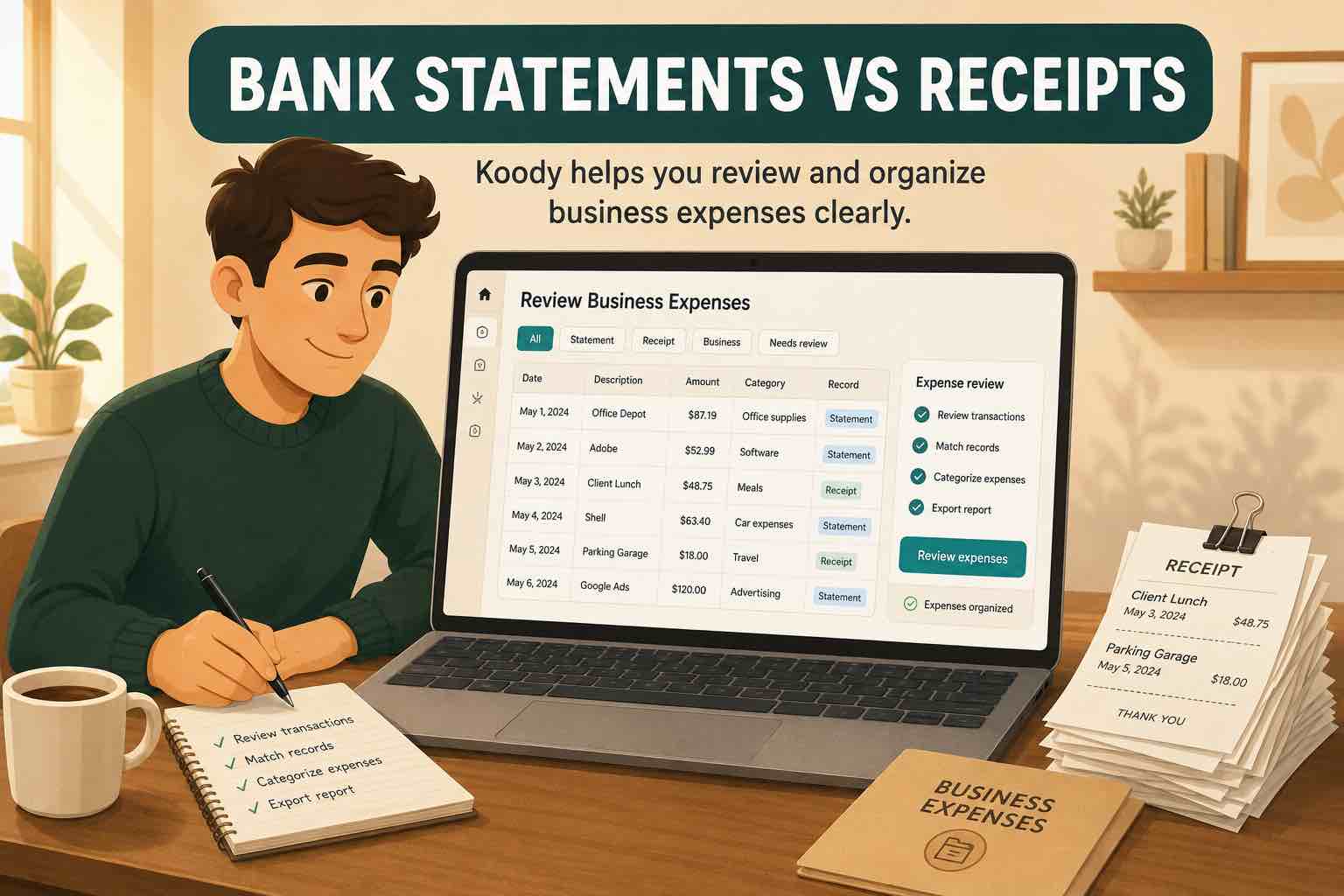
A bank statement can help show the date, merchant, and amount. It usually does not show who received the gift or why the gift was business-related. If you want a deeper answer on statements and receipts, read bank statements vs. receipts.
Separate business gifts from personal gifts in Koody.
Personal gifts and business gifts should not live in the same pile. Koody helps you keep Business Gifts separate from birthdays, holidays, family gifts, and other personal spending.
Open KoodyHow Koody helps before tax prep
Koody helps turn gift purchases into records that are easier to review.
- Import bank and card transactions when you need to catch up.
- Let Koody auto-categorize rows, then review gift purchases that need extra detail.
- Categorize business gifts as Business Gifts and personal gifts as Gifts.
- Attach receipts, invoices, screenshots, PDFs, and files to the matching transaction.
- Add recipient names, business relationships, and plain-English notes.
- Split one purchase if a receipt includes both personal and business items.
- Export filtered records when your accountant, tax preparer, or bookkeeper needs them.
This is useful if you manage household money and sole proprietor records in one place. A client gift, family birthday gift, holiday shopping trip, and customer appreciation gift can all look similar in a bank feed. Koody helps keep the business rows clear.
Import, review, attach notes, and export before tax prep.
Bring transactions into Koody, review Business Gifts, attach receipts, add recipient notes, split mixed purchases, and export records when tax season or accountant review comes around.
Get records ready in KoodyFAQs
1. Are business gifts tax deductible?
Business gifts may be deductible if they are given in the course of your trade or business, but the IRS generally limits the deduction to $25 per person per tax year. Keep the receipt, date, amount, gift description, recipient, and business purpose.
2. Is the $25 business gift limit per gift or per person?
The IRS limit is generally $25 per person per tax year, not $25 per gift. If you give the same client more than one business gift during the year, the gifts are usually combined for that person.
3. Do shipping, engraving, or gift wrapping count toward the $25 limit?
Incidental costs such as packaging, shipping, mailing, insurance, and engraving may be separate from the $25 limit when they do not add substantial value to the gift. Keep the receipt and let a tax professional review the final treatment.
4. Are branded business gifts deductible?
Some low-cost branded items that are clearly and permanently marked with your business name and widely distributed may be treated differently from regular gifts. Expensive branded gifts still need careful review.
5. Can I deduct gift cards for clients or customers?
Gift cards and cash-like gifts can be tricky. Keep the receipt, recipient name, business relationship, and reason for the gift, then ask a qualified tax professional how to treat it.
6. What records should I keep for business gifts?
Keep the date, amount, receipt or invoice, gift description, recipient name when needed, business relationship, and a short note explaining why the gift was connected to the business.
7. Can Koody decide whether my gift is deductible?
No. Koody helps organize the category, receipt, files, notes, splits, and export. A qualified tax professional should decide whether the gift is deductible and how much to claim.
Sources: IRS references used
Sources accessed June 9, 2026. Koody is not a tax filing service or tax advisor.