Loan and credit card records are easy to mix up. You might see a $500 credit card payment and think it was an expense, but the actual expenses may be ten purchases that happened earlier. You might see a loan payment and miss that only part of it was interest.
This guide is for sole proprietors, contractors, drivers, sellers, therapists, doctors, lawyers, barbers, hairdressers, creators, consultants, and side hustlers who want cleaner loan and card records before tax prep.
Important: Koody is a budgeting and record-prep app, not a tax filing service, tax advisor, accountant, tax preparer, lender, credit counselor, or law firm. Use Koody to organize transactions, statements, receipts, notes, splits, imports, and exports. A qualified tax professional should decide interest deductibility, allocation, debt treatment, and final tax treatment.
Business loan interest
Is business loan interest deductible on Schedule C?
Business loan interest may be reviewed as an interest expense when the borrowed money was used for the business. The IRS Schedule C instructions point to interest expense review and allocation rules.
The key record question is: what was the borrowed money used for?
- A loan used to buy business equipment may need one kind of review.
- A loan used partly for business and partly for personal costs needs notes and allocation review.
- A personal loan that happens to be repaid from the business account should not be blindly treated as a business expense.
Keep the loan agreement, statements, and notes showing how the funds were used.
Principal vs interest
Is loan principal a business expense?
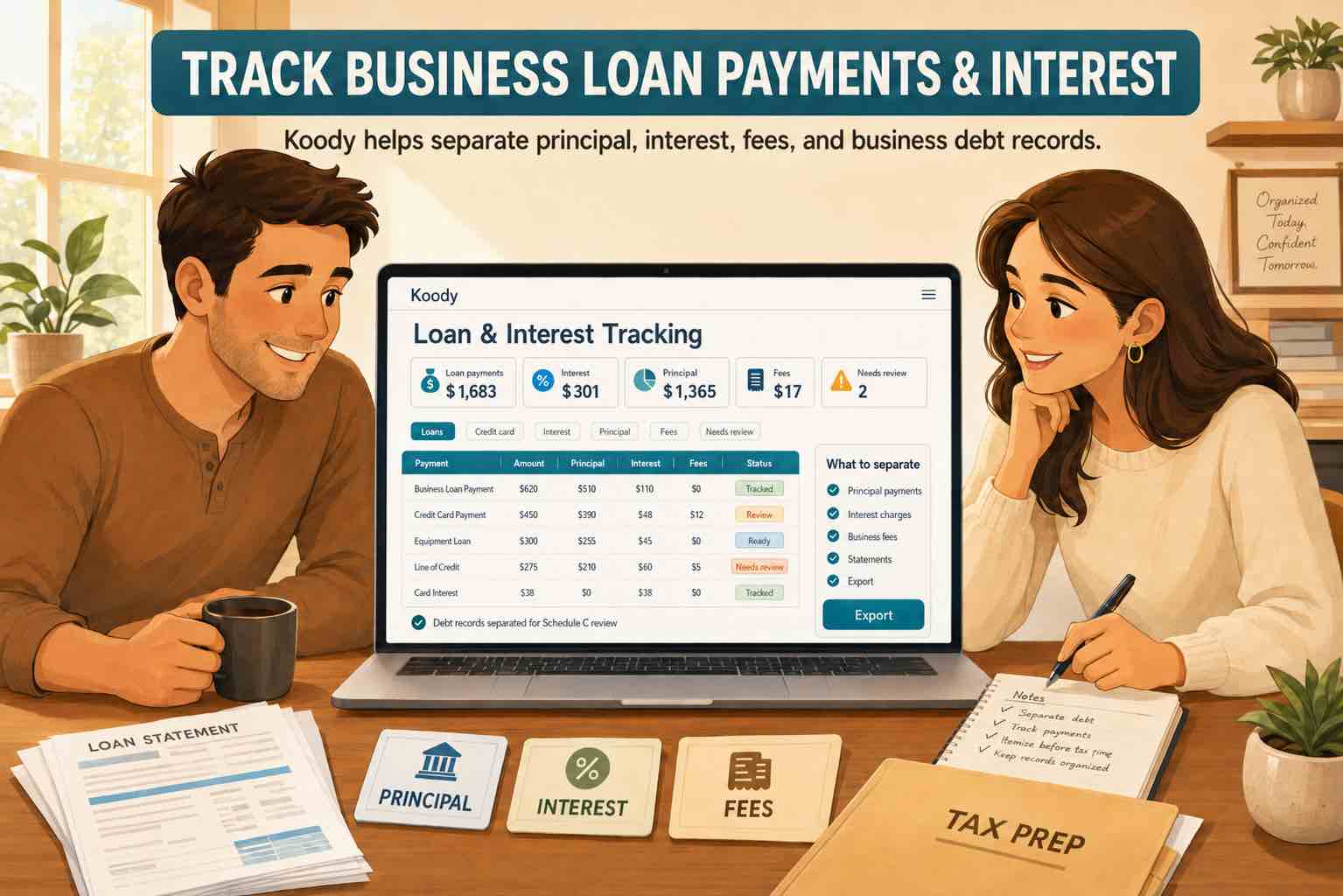
A loan payment can include principal and interest.
- Principal: the borrowed money being paid back.
- Interest: the cost of borrowing money.
A $600 monthly loan payment may include $470 of principal and $130 of interest. The bank account may show one $600 payment, but the lender's loan statement or payment breakdown explains the split.
That lender statement or payment breakdown is important. Without it, the payment row does not show which part may be reviewed as interest.
Keep loan statements and interest notes with the transaction.
Koody lets you attach statements, loan documents, receipts, screenshots, and notes to the matching row, so principal, interest, and business-use details are easier to review later.
Track interest records in KoodyCredit card interest
Is credit card interest a business expense?
Credit card interest may need review if the card was used for business purchases. If the card was used for both business and personal purchases, keep the statement and notes that help explain the business portion.
Example:
- A hairdresser uses a card for salon supplies, groceries, and personal travel.
- The card statement shows interest.
- The business purchases and personal purchases need to be separated before anyone reviews the interest.
In Koody, categorize the purchases first. Then keep the interest row and statement visible for review.
Credit card payments
Are credit card payments business expenses?
A credit card payment is usually money moving to the card balance. It is not the same as the original purchase.
If you buy $90 of supplies, $45 of software, and $30 of groceries on a credit card, those purchases carry the category information. The later $165 payment to the card is a payment toward the balance.
If you import both the card account and the checking account, Koody helps separate card purchases from card payments so the payment does not get counted as a second expense.
For more on importing card rows, read how to import credit card transactions.
Business use and mixed debt
A loan or card can be fully business, fully personal, or mixed. The records should show which one you are dealing with.
Helpful notes include:
- "Loan used to buy cleaning equipment."
- "Credit card interest on card used for business supplies and personal purchases."
- "Business line of credit used for inventory purchase."
- "Card payment from checking account, not a new expense."
- "Loan proceeds partly used for business equipment and partly personal."
If only part of a charge belongs with business records, split it by category in Koody and attach the statement.
What records to keep
Keep records that explain the debt, the payment, the interest, and the business use.
- Loan agreement or credit agreement.
- Monthly loan or card statements.
- Interest charged.
- Principal paid.
- Payment date and amount.
- Purchases tied to the card or loan.
- Receipts and invoices for business purchases.
- Notes showing how borrowed funds were used.
- Splits for mixed personal and business use.
- Exported records for accountant or tax-prep review.
How Koody helps before tax prep
Koody helps separate the rows that often get confused.
- Import checking, savings, loan, and card transactions.
- Let Koody auto-categorize rows, then review loan and card activity.
- Keep card purchases separate from card payments.
- Track loan principal, interest, and transfers in practical categories.
- Attach loan statements, card statements, receipts, PDFs, and screenshots.
- Add business-use notes for borrowed funds and mixed cards.
- Split mixed purchases by category.
- Export interest and statement records for review.
What to check before tax prep
Before tax prep, check for:
- Credit card payments counted as business expenses.
- Interest rows with no statement attached.
- Loan payments with no principal and interest split.
- Personal loan payments sitting in business categories.
- Mixed cards with no business-use notes.
- Business purchases on personal cards that need receipts.
- Transfers between accounts treated like income or expenses.
For a broader P&L review from bank rows, read how to create a profit and loss from bank transactions.
Import, review, attach statements, and export before tax prep.
Bring loan and card rows into Koody, review purchases and payments separately, attach statements, add business-use notes, and export records when needed.
Get interest records ready in KoodyFAQs
1. Is business loan interest deductible on Schedule C?
Business loan interest may be reviewed as a Schedule C interest expense when the borrowed money was used for the business. Keep statements, payment records, loan documents, and notes showing business use.
2. Is loan principal a business expense?
Loan principal is the borrowed money being paid back. It is usually tracked separately from interest because the interest portion and principal portion can be reviewed differently.
3. Is credit card interest a business expense?
Credit card interest may need review if the card was used for business purchases. If the card has both personal and business purchases, keep statements and notes so the business portion can be reviewed.
4. Are credit card payments business expenses?
A credit card payment is usually a payment toward the card balance, not the original business expense. The business expense is usually the purchase itself, while the payment is money moving to the card.
5. What records should I keep for business loan interest?
Keep loan agreements, monthly statements, payment records, interest charged, principal paid, business-use notes, account details, and records showing how the borrowed money was used.
6. How does Koody help with loan and credit card records?
Koody helps separate purchases, card payments, transfers, loan principal, interest rows, statements, receipts, notes, and exports for accountant or tax-prep review.
Sources: IRS references used
Sources accessed July 1, 2026. Koody is not a tax filing service or tax advisor.