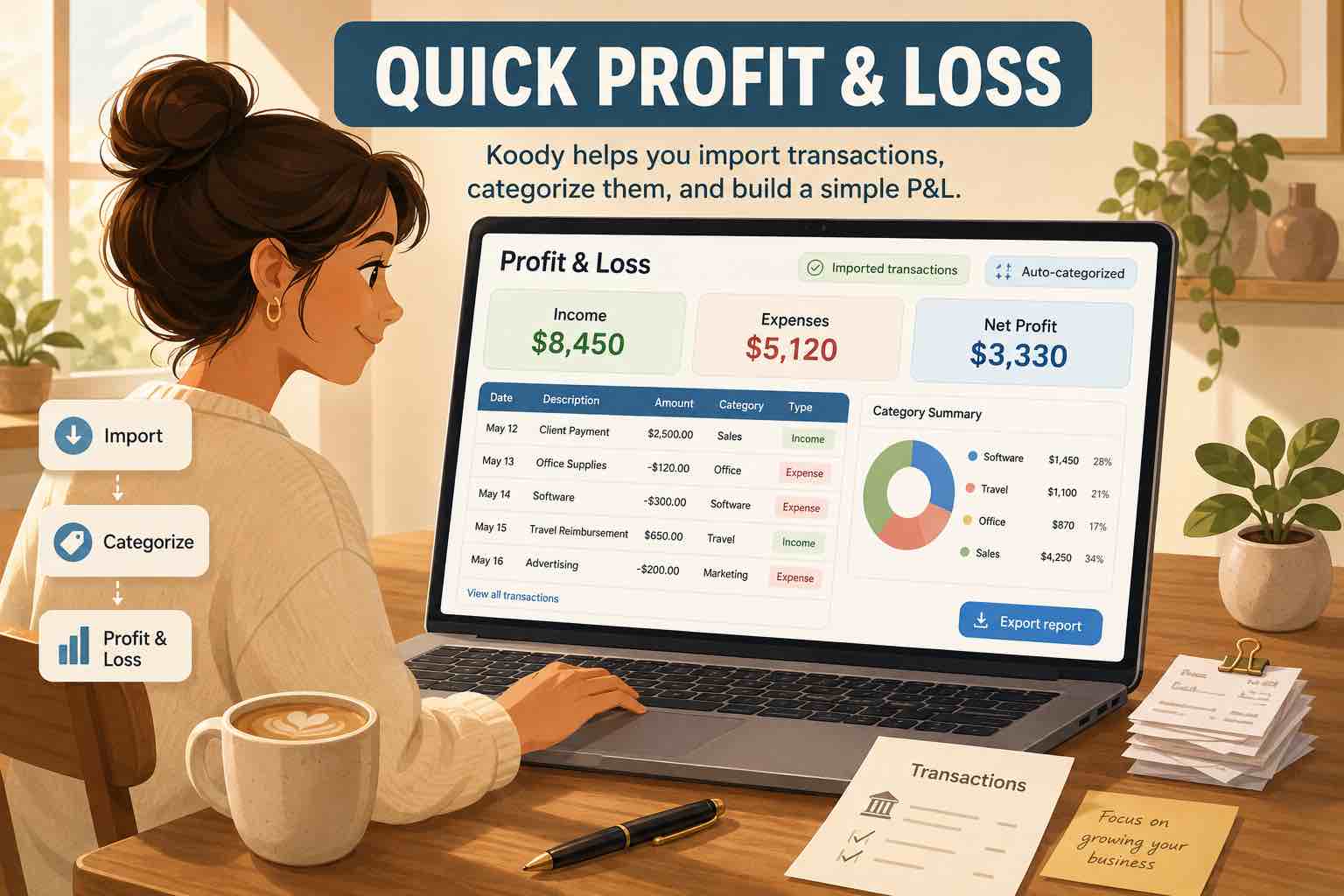

Paying yourself sounds like a payroll question, but a sole proprietorship works differently from a corporation. The money may move in seconds. The records still need to show that you took cash for yourself rather than paid a deductible business cost.
This article explains how owner's draws work, how to record both sides of the transfer, how personal purchases and owner contributions differ, and what to keep for tax prep.
Important: Koody organizes financial records and produces reports for review. It does not choose how you should pay yourself or determine the tax treatment. If your business has elected S corporation or C corporation taxation, ask your tax professional or payroll provider which rules apply.
How does a sole proprietor pay themselves?
For federal tax purposes, a sole proprietor is one person who owns an unincorporated business. A single-member LLC is generally treated the same way unless it elects corporate tax treatment.
When a sole proprietor wants to use business money personally, they usually take an owner's draw. A transfer from business checking to personal checking is a common method. You can also write yourself a check or withdraw cash. The payment method does not turn the withdrawal into wages or a business expense.
For example, Lena runs a hair salon as a sole proprietor. She moves $1,500 from business checking to her personal account for household rent and groceries. The business record should show a $1,500 owner's draw. Her personal account should show money moved between her own accounts, not a new paycheck from an employer.
What is an owner's draw?
An owner's draw is money or property removed from the business for the owner's personal use. The word "draw" describes the owner drawing value out of the business.
Owner's draws can include:
- A transfer from business checking to personal checking.
- A check written from the business to the owner.
- Cash taken from the business for household spending.
- Groceries, personal rent, or another personal purchase paid with the business card.
- Products or supplies taken from the business for personal use, when applicable.
The IRS describes a drawing account as a separate place to record business income withdrawn for personal and family expenses. Keeping these withdrawals together makes it easier to see how much cash left the business without treating it like advertising, supplies, rent, or another deductible cost.
Owner's draw vs salary
A salary is compensation paid to an employee through payroll. Payroll can include tax withholding, employer filings, wage reports, and payroll tax deposits.
The IRS says a sole proprietor is not an employee of their own sole proprietorship and cannot deduct their own salary or personal withdrawals. That is why a sole proprietor's payment to themselves is generally recorded as an owner's draw.
The answer can change when the business has a different tax classification. An LLC taxed as an S corporation or C corporation may have payroll and compensation requirements that do not apply to a default single-member LLC. Confirm the tax election before copying the owner's-draw method from another business.
Does an owner's draw reduce Schedule C profit?
No. Schedule C profit starts with business income and subtracts allowable business expenses. An owner's draw uses cash after it reaches the business, so it sits outside those income and expense totals.
Suppose Lena's salon earns $12,000 during a month and has $5,000 of reviewed business expenses. The resulting business profit is $7,000. If she transfers $3,000 to her personal account, the P&L still shows $7,000 of profit. The draw changes how much cash remains in business checking; it does not create another $3,000 expense.
Schedule C profit generally feeds into calculations for income tax and self-employment tax. The amount of an owner's draw does not replace that profit figure. A sole proprietor who leaves every dollar in the business may still have taxable profit. A sole proprietor who takes a large draw does not automatically create a larger business deduction.
Read our guide to self-employment tax for sole proprietors for a fuller explanation of how Schedule C profit can flow into Schedule SE.
How to record an owner's draw transfer
Use records that let you recognize both sides later. A useful entry includes the date, amount, business account, personal account, and a description such as "Owner draw - July."
When both accounts are in Koody:
- Create a transfer from the business account to the personal account.
- Categorize the transfer as Owner Draw / Personal.
- Check the date and amount, then add a useful description such as "Owner draw - July."
- Review the business P&L and personal budget to confirm the transfer is excluded from their totals.
When only the business account is in Koody, mark the outgoing transaction as a one-sided transfer and categorize it as Owner Draw / Personal. This records money leaving the business for personal use without creating a matching deposit in an account Koody does not track.
A $2,000 withdrawal and a $2,000 personal deposit are one movement of money. Counting the first as a business expense and the second as personal income invents two financial events that did not happen.
Keep owner's draws out of business expenses.
Mark the money movement as a transfer, categorize it as Owner Draw / Personal, and keep the withdrawal outside your Schedule C-style P&L.
Track an owner's drawPersonal purchases from a business account
A personal purchase paid directly from a business account is another form of owner's draw. If a rideshare driver uses the account that receives platform income to buy groceries, Groceries should not become a business vehicle expense simply because the business account paid the charge.
Place the personal amount in Owner Draw / Personal. If one receipt contains both business and personal items, split the transaction by category. A $220 warehouse-store receipt might include $80 of cleaning supplies for a client's property and $140 of household groceries. Attach or photograph the receipt, then split the two amounts instead of assigning all $220 to either side.
Regularly using the business account for personal spending creates more rows to review. The IRS generally recommends keeping business and personal accounts separate. If they have already been mixed, accurate categories and splits can still help you rebuild the record.
Owner contributions and reimbursements
Owner contributions
An owner contribution moves in the opposite direction from a draw. The owner puts personal money into the business. An Etsy seller might transfer $1,000 from personal savings to business checking before buying inventory.
Keep that deposit separate from Revenue. It did not come from a customer sale. Record the movement as a transfer and label it as an owner contribution or personal funds added to the business.
Reimbursements for business costs
A reimbursement can arise when the owner pays a real business expense personally and the business pays them back. Suppose a therapist uses a personal card for a $240 professional license renewal. Keep the renewal receipt and record the license cost with the business records. When the business repays the owner, connect the repayment to that cost instead of treating it as a second license expense or an owner's draw without explanation.
Reimbursement accounting can depend on the entity and the records involved. Keep the original expense, receipt, payment account, and repayment together so an accountant can review the treatment.
How much can a sole proprietor pay themselves?
There is no single draw amount or schedule that fits every sole proprietor. Some owners transfer a fixed amount every week or month. Others take money after checking current cash, upcoming bills, and expected income.
Start with the cash the business can actually spare. Profit and cash are related, but they are not identical. A business may show profit while waiting for clients to pay invoices. It may also have cash in the bank that needs to cover sales tax collected, quarterly estimated taxes, a credit card balance, refunds, inventory, rent, contractors, or next month's operating costs.
Before taking a draw, review:
- Cash currently available in business accounts.
- Bills and debt payments due before the next expected income.
- Refunds, chargebacks, payroll, or contractor payments that may be due.
- Inventory or supplies needed to keep working.
- Estimated tax money set aside for federal or state payments.
- A reserve for slower weeks or delayed client payments.
A regular draw can make household budgeting easier, but the amount should still reflect the business's real cash position. Ask a tax professional for help when you need a personal estimate or when your entity's tax status has changed.
How Koody keeps owner draws out of business expenses
Koody lets you manage the business account and personal budget in the same app. Record the money movement as a transfer, then categorize it as Owner Draw / Personal so the withdrawal does not become a business expense or personal income.
Koody can also help you:
- Import business and personal transaction files and auto-categorize eligible rows.
- Review transfers, refunds, card payments, owner draws, and ordinary expenses separately.
- Split a purchase between business and personal categories.
- Attach a receipt, invoice, PDF, screenshot, or mobile receipt photo.
- Add a short note when an unusual payment needs an explanation.
- Review the business categories in a Schedule C-style P&L.
- Export the reviewed transactions or email them directly to an accountant.
You decide whether each row is correct. Koody keeps the account history, category, receipt, and note together so the year-end review starts with an understandable record.
Records to review before tax prep
Review the owner's-draw account for the full tax year and check these details:
- Every draw has a date, amount, and recognizable description.
- Matching transfers between tracked accounts use the posted dates and matching amount.
- Personal deposits from draws are recorded as transfers, not business or household income.
- Personal purchases paid from business accounts are in Owner Draw / Personal.
- Mixed purchases are split and have the receipt attached.
- Owner contributions are separate from customer revenue.
- Reimbursements connect to the original business expense.
- Estimated tax payments are separate from Schedule C expenses.
- The P&L excludes draws, transfers, and personal spending from ordinary business expenses.
Compare the draw total with the business bank activity. An unexplained transfer can be corrected while the account and purpose are still recognizable.
FAQs
1. How do I pay myself as a sole proprietor?
A sole proprietor generally takes an owner's draw by moving money from the business for personal use. In Koody, create a transfer from the business account to the personal account, then categorize it as Owner Draw / Personal. If the personal account is not in Koody, mark the outgoing transaction as a one-sided transfer and use the same category.
2. What is an owner's draw?
An owner's draw is money or property a sole proprietor takes from the business for personal use. It may be a bank transfer, check, cash withdrawal, or personal purchase paid from a business account.
3. Is an owner's draw a business expense?
No. The IRS says a sole proprietor cannot deduct personal withdrawals or their own salary as business expenses. An owner's draw reduces the cash left in the business, but it does not reduce Schedule C profit.
4. Does an owner's draw go on Schedule C?
An owner's draw is not reported as an ordinary Schedule C expense. Keep it in a separate Owner Draw / Personal category so it does not get mixed into advertising, supplies, rent, contract labor, or other business expenses.
5. Can a sole proprietor pay themselves a salary?
For federal tax purposes, a sole proprietor is generally not an employee of their own sole proprietorship and cannot deduct their own salary. A business taxed as an S corporation or C corporation follows different compensation rules, so check the entity's tax treatment before paying yourself.
6. How do I record money moved from my business account to my personal account?
Create a transfer from the business account to the personal account, then categorize it as Owner Draw / Personal. If the personal account is not in Koody, mark the outgoing transaction as a one-sided transfer and categorize it the same way. Check the date and amount, then add a useful description.
7. What if I use the business card for a personal purchase?
Categorize the personal purchase as Owner Draw / Personal instead of a business expense. If the receipt contains both personal and business items, split the transaction by category and keep the receipt with the row.
8. Is putting personal money into the business an owner's draw?
No. Money moving from you into the business is an owner contribution. Label it separately from sales or client income so it does not inflate business revenue.
9. How does Koody track owner's draws?
Koody lets you create a transfer between tracked business and personal accounts or mark an outgoing transaction as a one-sided transfer when only the business account is tracked. Categorize it as Owner Draw / Personal, then review related transfers, split mixed purchases, and add receipts or notes.
Review your business and personal money together.
Use the correct transaction types and categories for owner's draws, account transfers, personal purchases, and business expenses, then review the Schedule C-style P&L before tax prep.
Organize your records in KoodySources: IRS references used
Sources accessed July 16, 2026. Koody is not a tax filing service or tax advisor.