If you are a sole proprietor, the line between "I bought something for work" and "this may be business property" can get blurry really quickly. A $22 pack of pens is different from a $1,400 laptop. A haircut cape is different from a barber chair. A cleaning spray is different from commercial cleaning equipment.
This guide explains what to separate before tax prep and what to write down while the purchase is still fresh. It is for freelancers, creators, barbers, hairdressers, therapists, lawyers, cleaners, contractors, drivers, sellers, and other sole proprietors who buy equipment for their work.
This article will show you how to separate business equipment from regular supplies, what details to save with bigger purchases, and how to keep useful notes for tax prep.
Important: Koody is a budgeting and record-prep app, not a tax filing service, tax advisor, accountant, tax preparer, depreciation service, or law firm. Use Koody to organize transactions, categories, receipts, files, notes, splits, imports, and exports. A qualified tax professional should decide depreciation, Section 179, listed property, recapture, and final tax treatment.
What counts as business equipment?
What is business equipment on Schedule C?
Business equipment is property you use in your business. It usually means something bigger or longer-lasting than a normal supply.
Common examples include:
- Laptop, desktop computer, monitor, tablet, or phone used for business.
- Camera, microphone, lighting, or editing gear for a creator.
- Printer, scanner, shredder, or legal office equipment.
- Barber chair, salon chair, dryer, mirror, or treatment table.
- Therapy office furniture, desk, chair, shelves, or waiting-room items.
- Cleaning equipment, vacuum, carpet cleaner, or pressure washer.
- Tools, machinery, ladders, shop equipment, or contractor equipment.
- Vehicle-related equipment used for the business.
A bank statement usually does not explain enough. It may only say Apple, Amazon, Best Buy, Home Depot, or Costco. The receipt shows what you bought. Your note explains how the item fits the business.
That small note helps later because the same merchant can mean very different things. Amazon could be printer ink, a laptop stand, household groceries, a camera lens, or a personal birthday gift. The category, receipt, and note help separate those stories.
Ordinary expense or longer-lasting asset?
Start with a simple question: did this purchase get used up quickly, or will it help the business for a while?
Things that get used up quickly are often easier to review as ordinary expenses. Things that stay useful for years may need asset, depreciation, or Section 179 review. You do not have to make the final tax call inside Koody. You just need the record to make sense.
A few examples:
| Purchase | Record-prep note |
|---|---|
| Printer paper | Add the receipt and categorize it as Office Expense or Supplies. |
| Printer/scanner | Add a note like "printer/scanner for legal documents" and flag it for equipment review. |
| Cleaning spray | Add the receipt and categorize it as Supplies. |
| Commercial carpet cleaner | Add a note like "carpet cleaner used for client jobs" and flag it for equipment review. |
| Camera memory card | Add a note if it belongs with creator gear or a specific business project. |
| Camera body | Add a note like "camera for paid product photography" and flag it for equipment review. |
A simple rule helps: ordinary supplies can go into normal expense categories, while bigger purchases should stay visible. If every business purchase goes into one broad category, your accountant has to hunt for equipment later.
What depreciation means in plain English
What is depreciation?
Depreciation is how the tax system handles many longer-lasting business purchases. Instead of treating a bigger purchase like a box of pens, the cost may be spread across years.
Imagine an Uber driver buys a phone mostly used for rideshare work, a dash cam, and a trunk organizer for airport runs. The phone and dash cam may last for more than one year. The IRS may not treat those items the same way it treats gas, parking, or a car wash.
Or imagine a barber buys a $1,800 chair. The chair helps the business serve clients over time instead of getting used up that week. A purchase like that may need depreciation or Section 179 review.
The IRS uses depreciation for property that is used in a business and lasts beyond the year. Equipment, furniture, machinery, computers, and some other property can fall into this review.
Your job before tax prep is to make the purchase easy to find and understand: what it was, what it cost, when it was ready for business use, and how much of the use was business.
What Section 179 means
What is Section 179?
Section 179 is a possible election that may let a business deduct the cost of certain qualifying property earlier instead of spreading the cost out through regular depreciation.
In plain English, Section 179 is something your accountant may consider when you buy qualifying business equipment. It has rules, limits, and business-income restrictions. It can also interact with listed property and business-use rules.
Do not bury a laptop, chair, camera, tool set, or machine inside a vague "business expenses" pile. Put it somewhere your accountant can see it, attach the receipt, and add the business-use note.
In Koody, a category like Business Equipment / Assets or Depreciation Review helps those purchases stand out before tax prep.
Keep equipment receipts and notes with the transaction.
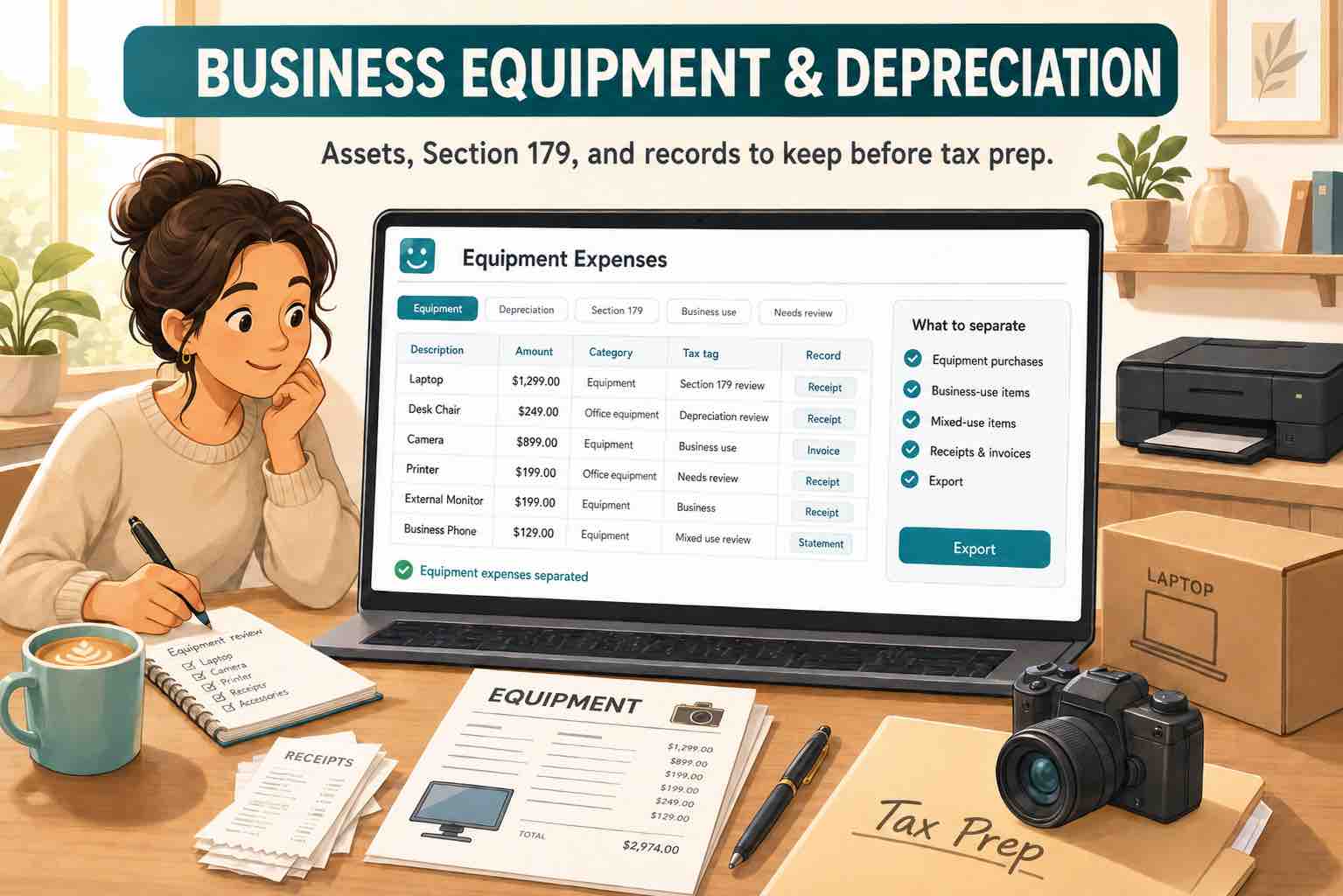
Koody lets you attach receipts, invoices, PDFs, screenshots, and notes to the matching row, so a laptop, chair, camera, printer, or tool purchase is easy to review later.
Track equipment in KoodyPlaced-in-service date
What does placed in service mean?
The placed-in-service date is when the equipment is ready and available for business use. It may not be the same as the date you paid for it.
If a therapist buys office furniture in May but opens the practice in July, the placed-in-service date may need review. If a creator buys a camera in March but starts using it for paid work in April, the note should say that.
Keep a short note on bigger purchases: "Bought June 4. Used for client video work starting June 12." That kind of note can save time during tax prep.
Personal and business use
Some equipment is used only for business. Some is mixed.
A barber chair in a shop is easier to explain than a laptop used for both client work and family use. A phone, car accessory, camera, or home office printer can also be mixed.
When use is mixed, keep a note that explains the business side. If one receipt includes business equipment and personal items, split the transaction by category in Koody so the business part does not hide inside personal spending.
Repairs vs improvements
Repairs and improvements can be reviewed differently.
A small repair may keep equipment working. A major upgrade may add value, extend useful life, or change the equipment enough that it needs separate review. For example, replacing a broken cord is different from upgrading a whole machine.
Use clear categories and notes. A Repairs & Maintenance category can hold routine fixes. Bigger upgrades can go to Business Equipment / Assets or Depreciation Review so they are not missed.
Sale, disposal, or trade-in records
Equipment records do not end when you buy the item. If you sell it, trade it in, stop using it, lose it, or dispose of it, keep a record.
Useful details include:
- Date sold, traded, discarded, or taken out of service.
- Sale price or trade-in value.
- Buyer, marketplace, or store receipt when available.
- Note explaining what happened.
- Original purchase record and receipt.
Your accountant may need these details if the item was depreciated, expensed, or used partly for business.
How Koody helps before tax prep
Koody helps keep equipment records next to the transaction instead of scattered across email, downloads, camera roll, and memory.
- Import bank and card transactions.
- Let Koody auto-categorize rows, then review larger purchases carefully.
- Categorize equipment as Business Equipment / Assets, Depreciation Review, Repairs & Maintenance, Supplies, or another useful business category.
- Attach receipts, invoices, PDFs, screenshots, warranty records, and order confirmations.
- Add notes for business purpose, placed-in-service date, business-use percentage, model details, and serial numbers.
- Split one transaction by category when a receipt includes equipment, supplies, and personal items.
- Export filtered records when your accountant, tax preparer, or bookkeeper needs them.
Koody is especially useful when you manage household money and sole proprietor records in one app. You can keep business equipment visible without losing the personal side of your budget.
Import, review, attach notes, and export before tax prep.
Bring bank and card transactions into Koody, review larger purchases, attach equipment records, add business-use notes, and export cleaner records when tax season comes around.
Get equipment records ready in KoodyWhat to check before tax prep
Before you send records to your accountant or tax preparer, review the purchases that may need equipment or depreciation attention.
- Large purchases: computers, cameras, furniture, machinery, phones, tools, chairs, and equipment.
- Placed-in-service dates: when the item was ready and available for business use.
- Business-use notes: especially for phones, laptops, cameras, vehicles, and home office equipment.
- Receipts and invoices: itemized proof showing what was bought.
- Model or serial details: useful for higher-value items.
- Repairs and improvements: separate routine repairs from bigger upgrades.
- Sale or disposal: trade-ins, marketplace sales, lost items, or equipment taken out of service.
- Mixed purchases: one receipt with business equipment, supplies, and personal items.
If a row is unclear, attach what you have and write a note. Bigger purchases are easier to review when the record is still fresh.
For broad Schedule C categories, read Schedule C expense categories explained. For startup purchases, read small business startup costs tax deduction.
FAQs
1. What is business equipment on Schedule C?
Business equipment is property you use for your business, such as a laptop, camera, printer, barber chair, tools, machinery, office furniture, or cleaning equipment. Bigger purchases often need separate review because they may last longer than one year.
2. What is depreciation?
Depreciation is the tax idea of recovering the cost of certain business property over time instead of treating the full purchase like a regular expense right away.
3. What is Section 179?
Section 179 is a possible election that may let a business deduct the cost of certain qualifying property earlier. It has limits and rules, so keep the records organized and let a qualified tax professional decide whether it applies.
4. Can I deduct a laptop for my business?
A laptop used for business may be deductible, depreciated, or reviewed under Section 179 depending on the facts. Keep the receipt, purchase date, placed-in-service date, business-use percentage, and note explaining how the laptop is used.
5. What records should I keep for business equipment?
Keep the receipt or invoice, date bought, date placed in service, amount, item description, serial or model details when useful, business-use percentage, repair records, sale or disposal records, and notes explaining business purpose.
6. Can Koody calculate depreciation?
Koody helps organize equipment transactions, receipts, files, notes, splits, and exports for review. Koody does not calculate depreciation, choose Section 179, or decide final tax treatment.
7. What if equipment is partly personal and partly business?
Keep a business-use note and split the transaction in Koody when only part of the cost belongs with business records. A qualified tax professional can decide how the business-use percentage should affect the tax return.
Sources: IRS references used
Sources accessed June 19, 2026. Koody is not a tax filing service or tax advisor.