
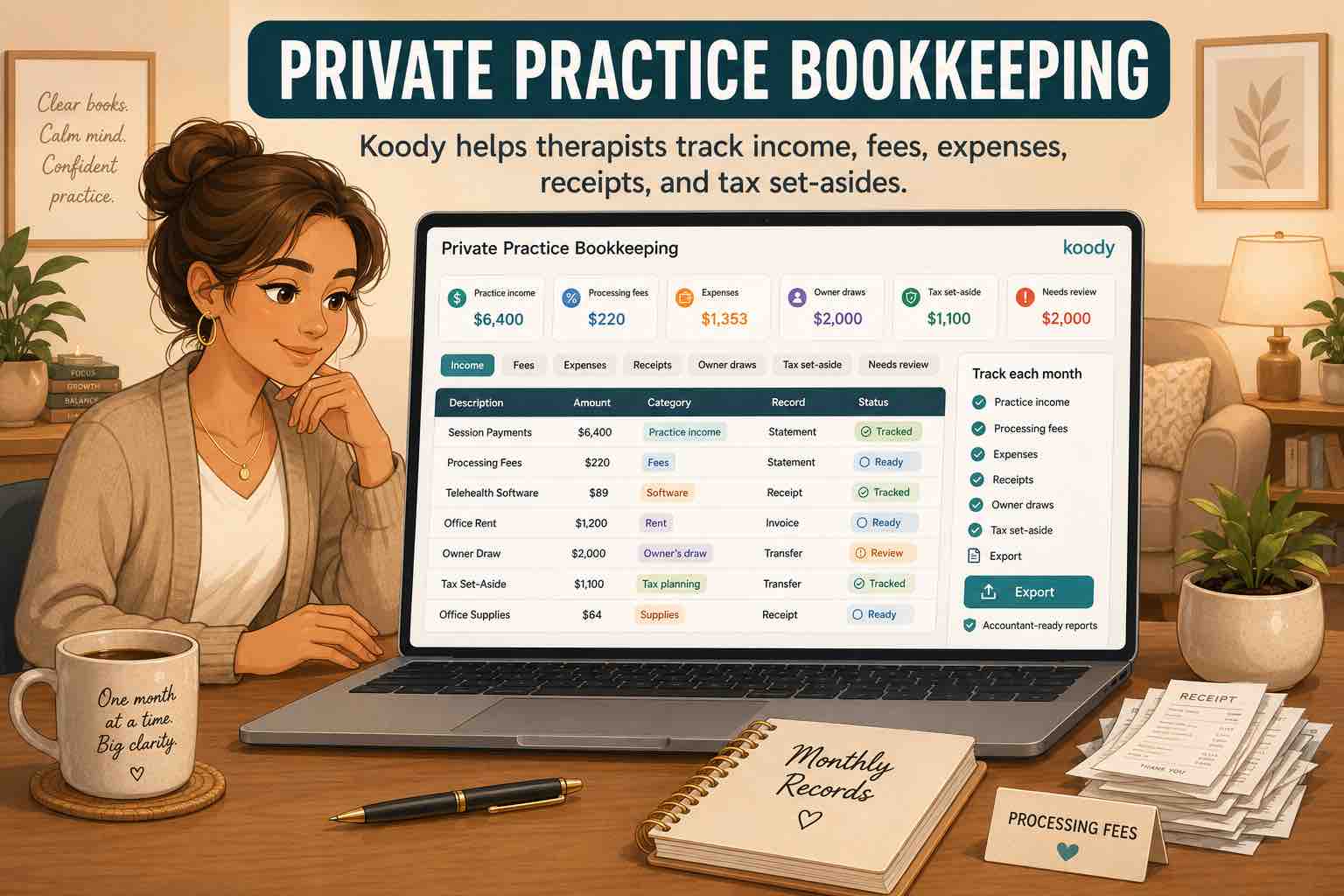
Therapy practices can receive money through several routes: self-pay sessions, copays, insurance remittances, platforms, employee-assistance programs, and contract roles. The deposit in the bank may be smaller than the amount billed or may combine several sessions into one payment.
Bookkeeping gives those deposits and expenses a financial record that can be reviewed month by month. Clinical notes and billing records still belong in the systems your practice uses for patient care and claims.
Important: Koody is a budgeting and financial recordkeeping app. It does not serve as an EHR, claims platform, payroll service, tax filer, or tax advisor. Do not put client names, diagnoses, treatment details, insurance member IDs, or clinical notes in Koody.
What does bookkeeping mean for a therapist?
Bookkeeping is the financial record of what the practice earned, what it spent, and how money moved between accounts. Each row should help you answer a basic question: was this practice income, a practice expense, a personal transaction, a transfer, a refund, an owner's draw, or a tax payment?
The record usually has several layers:
- Billing or payer records show sessions billed, allowed amounts, adjustments, and payments.
- Bank, card, and processor records show money received or paid.
- Receipts and invoices explain purchases and professional services.
- Bookkeeping categories group income and expenses for review.
- A P&L totals practice income and subtracts practice expenses for a chosen period.
These records serve different jobs. A $1,800 insurer deposit shows that money reached the bank, but the remittance may be needed to explain which claims, adjustments, or sessions produced that total. Keep clinical and claim detail in the appropriate practice system and use the bank row for the financial amount.
Income to track in private practice
Record every source of practice income, including amounts that do not arrive through the main business checking account. Common sources include:
- Self-pay client payments and copays.
- Insurance company payments.
- Payments from therapy, telehealth, or billing platforms.
- Contract work for a group practice, hospital, school, or employee-assistance program.
- Workshops, supervision, consultation, speaking, or training income.
- Cash or check payments.
- Books, courses, digital products, or other practice income not included above.
A cash payment needs to be entered even though there is no bank transaction to import. Record the date, amount, income category, and a neutral description such as "Client payment." Keep any client-specific billing record in the practice system.
Compare monthly income totals with invoices, payer reports, processor reports, platform statements, Forms 1099, and bank deposits. A Form 1099 can help with year-end review, but the bookkeeping record should include all business income whether or not a form arrives.
Insurance deposits, client payments, fees, and refunds
One deposit may cover several payments
An insurance payment may combine several claims. A therapy platform may combine a week of sessions. A card processor may subtract fees before depositing the remainder. The bank row alone cannot always show the full calculation.
Suppose a processor collects $1,600 from clients, keeps $48 in processing fees, and deposits $1,552. The processor report identifies the gross payments, fee, and net deposit. Keep that report and separate Revenue from Payment Processing Fees when your records and accounting method call for gross income and a separate fee expense.
For an insurer deposit covering several sessions, match the deposit total to the remittance in your billing or practice system. The Koody description can remain neutral, such as "Insurance payment - June remittance." It does not need client names or treatment details.
Refunds and adjustments
Keep client refunds separate from ordinary practice expenses. Use the same neutral description and income category as the original payment when possible, then tag the repayment as a refund. This makes the amount received, the amount returned, and any difference easier to compare.
Contractual adjustments and claim denials do not always create bank transactions. Keep those details in the billing or claims system. The bookkeeping record should reflect the money that was actually received or paid under the accounting method used by the practice.
Private-practice expense categories
Categories should describe the financial job of the purchase. They help you review spending, prepare a P&L, and give an accountant totals they can trace back to individual transactions.
Common private-practice records include:
- Office and room costs: office rent, coworking fees, room rental, utilities, cleaning, and eligible home office records.
- Practice software: EHR, telehealth, scheduling, billing, secure messaging, bookkeeping, and website subscriptions.
- Marketing: website hosting, directory listings, advertising, photography, and printed materials.
- Professional costs: license renewals, continuing education, supervision, consultation, memberships, and professional publications.
- Insurance: professional liability, general liability, property, cyber, or other business policies.
- Payment and platform fees: card processing, platform commissions, bank fees, and billing service charges.
- Office costs: furniture, equipment, computer, phone, internet, supplies, postage, and repairs.
- Professional services: bookkeeping, accounting, legal services, contractors, virtual assistants, and billing help.
- Travel and vehicle records: business travel, parking, tolls, and mileage records when they apply.
A professional expense and a personal healthcare expense can look similar on a card statement. A therapist's own treatment, family health insurance, and continuing education should not be placed in the same category simply because all three relate to health. Keep the transaction records separate and let an accountant determine final tax treatment.
When a bill serves both the practice and personal life, split it. A $140 phone bill might be divided between Business Utilities and the personal phone category based on a supportable business-use allocation. Attach the bill and add a short financial note explaining the split.
Keep practice expenses and receipts together.
Categorize the transaction, take a receipt photo or attach the invoice, and add the financial note needed to explain an unusual purchase or mixed bill.
Organize practice expensesSeveral 1099 jobs or income sources
A therapist may run a solo practice, see clients through a platform, and work as an independent contractor for a group practice during the same year. Keep each payer or contract source recognizable so deposits and Forms 1099 can be checked later.
Record the payer, date, gross or net amount supported by the payer statement, any fees, and the account that received the money. Use a consistent neutral description, such as the group practice or platform name. Do not add the names of clients seen through that payer.
If the activities are part of the same sole proprietorship, your accountant may report them on one Schedule C. If they are separate businesses, separate records may be needed. Ask the accountant how they want the income grouped before year-end.
Owner draws, transfers, and tax set-asides
Money moved from practice checking to personal checking is generally an owner's draw for a sole proprietor. Keep it in Owner Draw / Personal rather than Office Expense, Contract Labor, or another Schedule C category.
A transfer between two practice accounts is account movement. A credit card payment is also account movement; the purchases on the card are the expense records. Counting the card payment and the purchases would double the spending.
Keep quarterly estimated tax payments in an Estimated Tax Payment or Owner Tax Payment category. Federal estimated income tax payments are not ordinary Schedule C expenses. Save the payment date, amount, tax period, confirmation number, and account used.
Read our guide to paying yourself as a sole proprietor for a complete owner's-draw example, and our guide to quarterly estimated taxes for payment records and review dates.
What to keep out of financial transaction notes
HHS explains that protected health information can include identifiable information about a person's health care and payment for that care. Names, diagnoses, appointment details, member IDs, and claim information can identify a client or reveal treatment.
Koody is for the practice's financial records. Keep client charts, clinical notes, treatment plans, claim details, and payer remittances with client information in the systems your practice uses for those records.
Use neutral financial descriptions in Koody:
- "Client payment" instead of the client's name or diagnosis.
- "Insurance payment - June remittance" instead of a list of patients or claim numbers.
- The processor, platform, group practice, or insurer name when that is enough to identify the source.
- "Professional consultation" instead of the subject of a client case.
Before attaching an invoice, screenshot, or PDF, check whether it contains client information. Attach ordinary business bills and receipts. Keep clinical or patient-linked documents in the appropriate secure system.
A practical monthly bookkeeping routine
Choose a regular date after the last bank and card transactions for the month have posted. Then work through the financial records in this order:
- Add transactions entered outside the bank, including cash or checks that have not yet been deposited.
- Import the month's original bank and card transaction files into the matching Koody accounts when using transaction imports.
- Let Koody auto-categorize eligible imported transactions.
- Review client, insurer, platform, and contract income against billing and payer reports.
- Separate processing fees, refunds, account transfers, card payments, owner draws, and tax set-asides.
- Split phone, internet, home office, supply, or other bills used partly for personal purposes.
- Take receipt photos or attach bills and invoices to the matching transactions.
- Add only the financial note needed to explain an unusual purchase, fee, or allocation.
- Review category totals and create the P&L for the month or year to date.
You review the results and change anything that does not match the practice records. For recurring merchants, Koody can remember eligible category and description edits so later imports need fewer changes.
End with a short list of questions for the accountant: an equipment purchase, a home office calculation, an unclear payer adjustment, or a transaction that may belong to another business.
How Koody helps therapists manage personal and business money
Koody keeps household accounts and practice accounts in the same app. Personal categories stay useful for the home budget, while business categories organize Revenue, Payment Processing Fees, Insurance, Licenses, Continuing Education, Professional Services, Office Expense, Owner Draw / Personal, Estimated Tax Payments, and other practice records.
Koody can create a budget from the accounts and spending history you choose. It can also import and auto-categorize transactions, clean descriptions, identify transfers and refunds, support split transactions, hold receipts and files, and prepare a Schedule C-style P&L.
The result is one place to see whether the household budget is working and whether the practice is earning enough to cover expenses, tax set-asides, and owner draws. The personal and business totals remain reviewable through their own categories and reports.
What to prepare for an accountant
An accountant may request a different package based on the practice, but a useful starting point includes:
- A reviewed P&L for the tax year.
- Categorized income and expense transactions behind the report.
- Forms 1099, payer summaries, and processor reports.
- Receipts and invoices for practice expenses.
- Contractor payments and W-9 records when applicable.
- Equipment, home office, vehicle, insurance, license, and continuing-education records when applicable.
- Estimated tax payment confirmations.
- A list of unusual transactions or unresolved questions.
In Koody, filter the reviewed transactions by date and account, choose CSV, Excel, or JSON, and send the export directly to the accountant from the Export screen. Koody can email a copy to you as well.
Ask the accountant how they want sensitive tax documents delivered. Use their secure portal for documents containing Social Security numbers, taxpayer identification numbers, health insurance details, or client-linked billing information.
FAQs
1. What bookkeeping records should a private-practice therapist keep?
Keep records of client and insurance income, platform and processing fees, refunds, practice expenses, receipts, invoices, owner draws, tax payments, and account transfers. Review the transactions behind your P&L and retain the separate clinical or billing records required by your practice.
2. How should therapists track insurance payments and client payments?
Record the payer, date, amount received, income source, and any fee or adjustment shown by the remittance or processor report. One deposit may cover several sessions, so keep the billing detail in the appropriate practice system and use a neutral financial description in Koody.
3. What business expenses should a therapist record?
Common records include office or room rent, EHR and telehealth software, directory listings, processing fees, professional liability insurance, licenses, continuing education, supervision, phone and internet, office supplies, memberships, contractors, and professional fees. Final tax treatment depends on the facts.
4. How do I track income from several 1099 therapy jobs?
Use a consistent income category and identify each payer or contract source without adding client details. Compare deposits with invoices, platform statements, and Forms 1099, and keep transfers between your own accounts out of income.
5. Should a therapist use client names in financial transaction notes?
Avoid putting client names, diagnoses, treatment details, insurance member IDs, or clinical notes in Koody. Use neutral financial descriptions such as Client payment, Insurance payment, or the payer or processor name, and keep clinical records in the system your practice uses for them.
6. How should I track owner draws and estimated tax payments?
Use the Owner Draw / Personal category for money taken from the practice for personal use. Keep estimated tax payments in their own category rather than treating them as a Schedule C expense. Account transfers should not become new income or new expenses.
7. Does a therapist need full accounting software?
That depends on the practice. Koody handles budgets, income and expense records, categories, receipts, splits, P&L reports, and accountant exports. A practice with payroll, invoicing, claims management, accrual accounting, or more complex entities may also need specialized systems and professional help.
8. Can Koody prepare a private-practice P&L?
Yes. Koody can create a Schedule C-style P&L from reviewed income and expense transactions for a selected period. Check the categories and totals against billing, processor, bank, and card records before relying on the report.
9. Can I share Koody records with my accountant?
Yes. Koody can export filtered transactions as CSV, Excel, or JSON. From the Export screen, you can enter your accountant's email address and send the transaction export directly, with an optional copy to yourself.
Review the practice before tax prep.
Create the Schedule C-style P&L, check the income and expense records behind it, and email the reviewed transaction export to your accountant from Koody.
Prepare practice records in KoodySources: IRS and HHS references used
Sources accessed July 16, 2026. Koody is not a tax filing service or tax advisor.