At a glance
An ATM withdrawal moves money from your bank account into cash. If you track each cash purchase, record the withdrawal as a transfer to a cash account, then record the purchases as expenses from that account.
If you prefer a simpler budget, categorize the full withdrawal as cash spending and leave the individual purchases out. Use one method consistently so the same money only appears once in your spending totals.
Koody lets you add a Cash bank with a Wallet account, create transfers, record cash expenses, attach receipt photos, and compare the account balance with the money in your wallet.
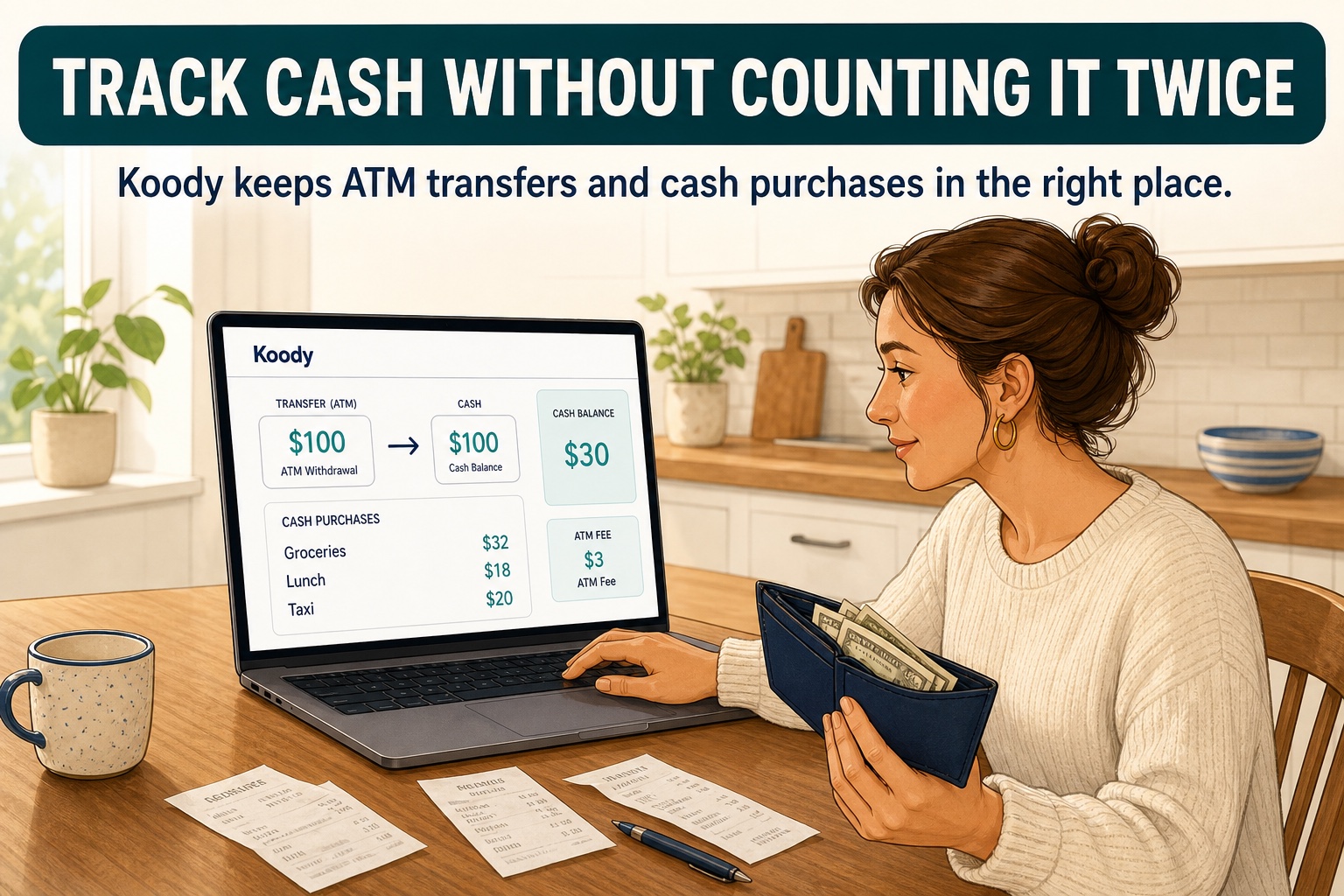
Open KoodyYou take $100 from an ATM. Suppose your bank posts one $103 transaction because the withdrawal included a $3 fee. Over the next few days, you use some of the cash for lunch, groceries, and a taxi. By Sunday, $30 is still in your wallet.
Your bank knows that $103 left checking. It does not know where the $100 went, how much remains, or which spending categories should change. A budget needs one clear rule for what happens after the withdrawal.
Is an ATM withdrawal an expense?
The $100 withdrawal moved money from checking into your wallet. You still own it, so a detailed budget records that movement as a transfer from the checking account to a cash account. The expenses happen when you spend the cash.
The $3 ATM fee is the cost of accessing the cash. Record that amount as an expense, usually under Bank Fees.
A simpler budget can count the withdrawal as spending as soon as the cash leaves the bank. That method works when you do not need every coffee, tip, fare, or market purchase in a separate category. The later cash purchases stay out of the budget because the withdrawal has already counted them.
Count the money once. Detailed tracking counts the purchases. Simple tracking counts the withdrawal.
Choose how much cash detail you want
Start with the question you want the budget to answer.
Use a cash account when you want to know where the cash went
This method fits people who use cash often, divide it across several categories, need receipts for reimbursements, or pay business expenses in cash. Your wallet has a balance, and every purchase reduces it.
Count the withdrawal when you only need a spending allowance
This method fits occasional cash use or a fixed amount of pocket money. You decide that the cash is spent for budget purposes when you withdraw it. The category may be Cash Spending, Dining, Transport, or another label that describes the plan for the money.
The simpler method gives up item-level categories and may show leftover cash as already spent. The cash-account method takes a few more entries and preserves the detail. Pick the level you will keep using.
Method 1: Use a cash account
Think of your wallet as another account. The ATM withdrawal moves money into it, and each cash purchase moves money out.
- Add a Cash bank with a Wallet account in Koody.
- Create a $100 transfer from Checking to Wallet when you withdraw the cash.
- Record the $3 ATM fee as an expense in the checking account.
- Add each cash purchase as an expense from Wallet and choose its category.
- Attach a receipt photo or add a short note when you may need the details later.
Suppose you spend $18 on lunch, $32 on groceries, and $20 on a taxi. Those three expenses reduce the Wallet balance from $100 to $30. Checking shows the transfer and fee. Your spending totals show $70 of purchases and $3 of bank fees.
The transfer keeps the $100 movement out of ordinary spending. The individual expenses carry the categories. Your Wallet balance tells you how much cash should still be on hand.
If an ATM withdrawal appears in a statement import, Koody can identify the cash movement as a transfer for you to review. Statement imports are included in Koody's Plus plan.
Method 2: Count the withdrawal as cash spending
Some people want the budget to show that $100 left the spending plan without recording every purchase afterward. In that setup, change the withdrawal to an expense and choose the category that best describes the cash.
If you took out $60 for a farmers' market and $40 for weekend transport, you can split the $100 withdrawal across Groceries and Transport using Koody's split transaction feature. If the money is a general allowance, use one cash-spending category you recognize.
Leave the later purchases out of Koody. Adding them after the withdrawal would count the same $100 again.
Cash left in your wallet at the end of the month has already appeared as spending under this method. That is the tradeoff for fewer entries. You can carry the physical cash forward without recording it again.
ATM fees, cash back, and cash deposits
ATM fees
Banks and ATM operators may charge fees for a withdrawal. When a fee appears as its own statement row, categorize it as Bank Fees. If one $103 row combines $100 of cash with a $3 fee, keep a $100 transfer and a $3 expense so the records add up to the total taken from checking.
Cash back at a store
A debit-card charge can include a purchase and cash back. If a $100 supermarket row contains $60 of groceries and $40 of cash back, record $60 as Groceries and $40 as a transfer to Wallet. The two records should add up to the amount on the bank statement.
Cash deposited into checking
Money returned from your wallet to checking is a transfer from Cash to Checking. Cash you just earned may be income. If you already recorded that income in the Cash account, mark the later bank deposit as a transfer so the income is not counted again.
Cash used for business
A cash withdrawal from a business account does not explain what the business bought. Record the actual cash payments and keep the details behind them.
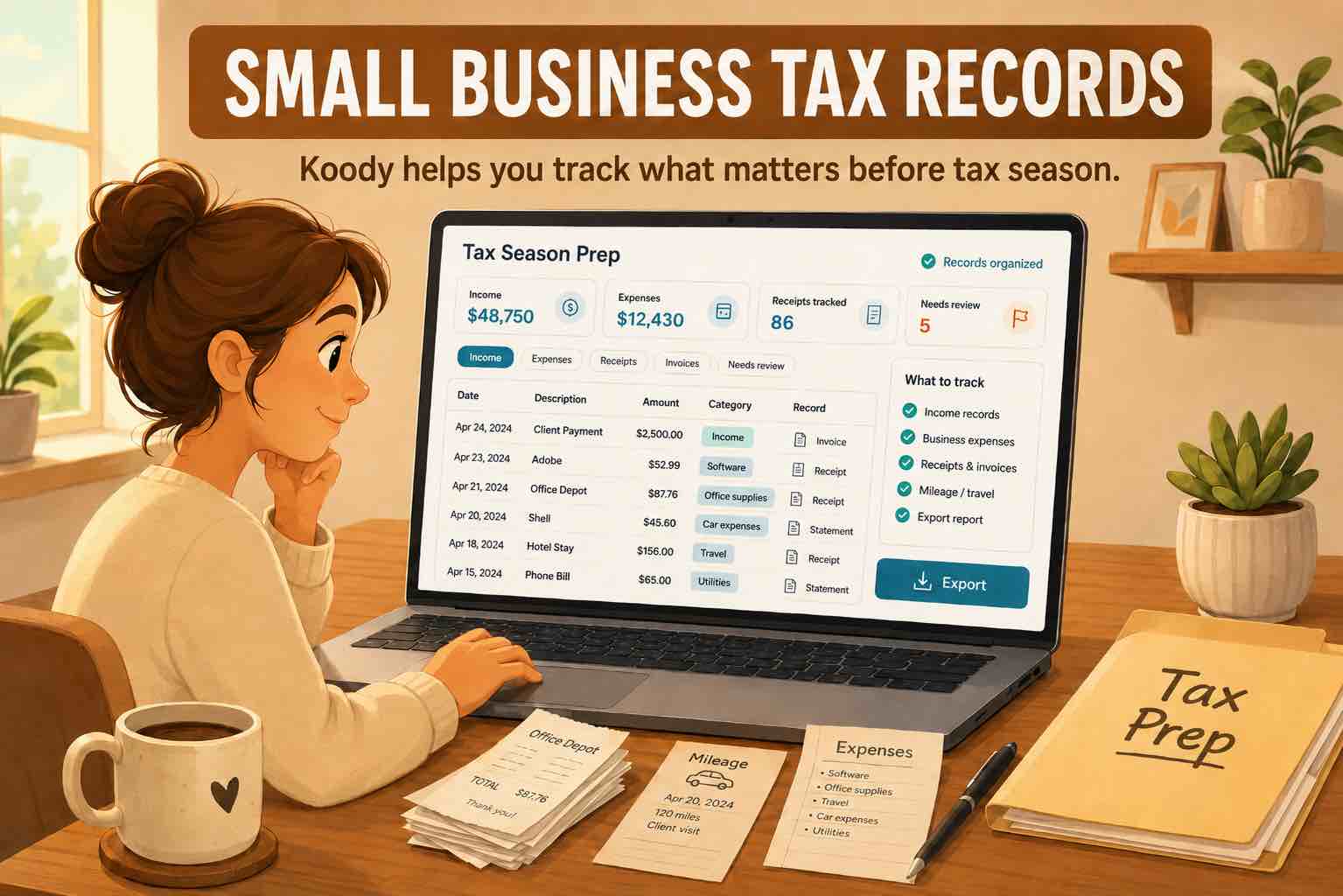
The IRS lists receipts and petty-cash slips among the records that can support business expenses. Publication 583 also says that when you cannot get a receipt for a cash payment, you should make an adequate explanation in your records at the time of payment.
For each business cash expense, keep the date, amount, merchant, category, receipt when available, and a short business-purpose note when the purchase is not obvious. Our small business recordkeeping guide explains the full transaction checklist.
Cash taken from the business for personal use belongs outside ordinary business expenses. A sole proprietor can treat that movement as an owner's draw and keep it out of the Schedule C-style P&L. Read our guide to paying yourself as a sole proprietor for the account and transfer steps.
Cash income needs the same care. Record it when you receive it. If you later deposit that recorded cash into checking, use a transfer between the accounts so the deposit does not become a second copy of the income.
How to track cash in Koody
Add a Cash bank with a Wallet account when you want detailed tracking. Create a transfer in Koody to move money from Checking to Wallet, then add each cash purchase to Wallet as an expense. Choose the category, take a photo of the receipt on mobile, and add a note when the purpose needs an explanation.
For the simpler method, open the ATM withdrawal in the checking account, set its type to Expense, and choose or split the cash-spending categories. Do not add the purchases that follow.
Both methods keep cash beside your card and bank activity. The difference is where the spending gets recorded: at the purchase for detailed tracking, or at the withdrawal for simple tracking.
Give cash a proper place in your budget.
Track the Wallet balance and each cash purchase, or keep things simple by counting the withdrawal once. Koody supports both approaches.
Track cash in KoodyCheck the cash balance
Detailed cash tracking works best with a quick count once a week or at the end of the month. Compare the physical cash in your wallet with the Wallet balance in Koody.
If they differ, look for a purchase you forgot to enter, a tip without a receipt, cash given to someone, or a fee recorded in the wrong account. Add the transaction you can identify. When the exact purchase is gone from memory, record a cash adjustment with a note instead of assigning the amount to a merchant or business expense you cannot support.
People using the simple method do not need to reconcile the wallet. The withdrawal already represents the spending in the budget.
FAQs
1. Is an ATM withdrawal an expense?
The cash itself is money moved from your bank account into your wallet. If you track a cash account, record the withdrawal as a transfer and record each cash purchase as an expense. If you do not want to track a separate cash account, categorize the withdrawal as cash spending and do not enter the purchases again. An ATM fee is an expense.
2. How do I track cash spending in a budget?
Choose one of two methods. For detailed tracking, move each withdrawal into a cash account and record purchases from that account. For simpler tracking, count the withdrawal as spending when you take out the cash and do not add the purchases separately.
3. Should I create a cash account in my budgeting app?
A cash account is useful when you want to know how much is in your wallet and which categories the cash purchases belong to. If you only use cash occasionally, one cash-spending category may be enough.
4. How do I avoid counting cash twice?
Count either the withdrawal or the individual cash purchases. Detailed tracking counts the purchases and treats the withdrawal as a transfer. Simple tracking counts the withdrawal and leaves the later purchases out.
5. How should I track an ATM fee?
Record the fee as an expense, usually under Bank Fees. If one statement row combines the cash and fee, keep separate records for the cash transfer and the fee so the two amounts add up to the total taken from checking.
6. What if I lost the receipt for a cash purchase?
Record the date, amount, merchant, category, and what you bought while you still remember. For a business expense, the IRS says to make an adequate explanation in your records at the time of payment when you cannot get a receipt.
7. How should a sole proprietor track cash expenses?
Record each cash expense instead of treating the whole ATM withdrawal as a business expense. Keep the receipt or another supporting record, add the business purpose when it is not obvious, and separate any cash taken for personal use.
8. Can I track cash in Koody?
Yes. Add a Cash bank with a Wallet account, create transfers when money moves between checking and cash, record cash purchases against the Wallet account, and attach receipts or notes to the transactions.
Track cash with the rest of your money.
Keep ATM transfers, cash purchases, receipt photos, categories, and account balances together in Koody.
Open KoodySources
Sources accessed August 27, 2026.