
The choice affects which period a payment belongs to. A busy December can look very different depending on whether you count the work completed that month or the money customers actually paid. Understanding that difference helps you read your reports and keep the right records.
Important: This guide explains accounting methods for US sole proprietors. It is general information, not individual tax advice. Check the rules that apply to your business before choosing or changing your tax accounting method.
What does cash accounting mean?
Under the cash method, income generally counts when you receive it, and deductible expenses generally count when you pay them. Cash accounting covers bank transfers and other payment methods too; it does not mean that you must be paid in physical cash.
For a barber paid after each appointment, the work and payment usually happen together. Keeping records of those payments can be straightforward. For a consultant waiting several weeks for payment, the cash report may show a quiet month even though plenty of work was completed.
For tax purposes, money made available to you without a substantial restriction can count as received even if you have not deposited it. Equipment and advance payments also have special rules. Paying for something does not automatically make the entire amount an immediate deduction.
What does accrual accounting mean?
Accrual accounting generally recognizes income when you earn it and expenses when you incur them. It includes amounts customers owe you and amounts you owe suppliers. The date money reaches or leaves the bank is not necessarily the date the income or cost belongs in the report.
This can help when work, billing, and payment happen in different months. You need records showing what was delivered, what is owed, and when it belongs in the accounts. For US tax deductions, the liability must generally be fixed, measurable, and meet the economic-performance rules; receiving an invoice alone is not always enough.
How do the methods treat one invoice and one unpaid bill?
Suppose a cleaner completes a $1,200 commercial cleaning job in November. Another cleaner provides $200 of help on that job. Both amounts are agreed, the services are complete, and neither payment happens until December. Assume there are no other transactions or special tax timing rules in this example.
- Cash method: November has no income or expense from this job. December has $1,200 of income and a $200 expense, leaving $1,000 profit.
- Accrual method: November has $1,200 of income and a $200 expense, leaving $1,000 profit. December's payments settle the amounts owed; they do not create another $1,000 of profit.
Across the two months, the job produces the same $1,000 profit. The difference is timing. Under accrual accounting, November's profit does not mean the cleaner already has $1,000 available to spend. Under cash accounting, November's zero does not mean no work was done.
Which method should a sole proprietor choose?
Start with how you get paid and what you need to understand about the business. If customers normally pay at the appointment and costs are paid promptly, cash records may give you the information you need with less administration. If customers pay long after delivery, tracking what they owe becomes more important.
Ask these questions before deciding:
- Do I mainly provide services, or do I buy and sell stock?
- Do unpaid invoices or bills regularly cross month-end?
- Do I need reports about completed work, received payments, or both?
- Have I already established a tax accounting method on a filed return?
Inventory can affect the permitted treatment of purchases and sales. Eligible small businesses have exceptions, but being a sole proprietor alone does not settle that question. Check the inventory rules before choosing a method for a shop or other business selling goods.
Can you change from cash to accrual later?
Yes, but changing an established tax accounting method generally requires IRS approval through Form 3115. Automatic consent procedures exist for qualifying changes; they still have requirements. A change may also need an adjustment so income or expenses are neither counted twice nor missed.
Do not switch the treatment of individual payments simply to improve a month's result. Keep the method consistent and retain the records needed to explain any approved change. A different view in a report does not, by itself, change your tax accounting method.
Turn business payments into a P&L and tax-prep records.
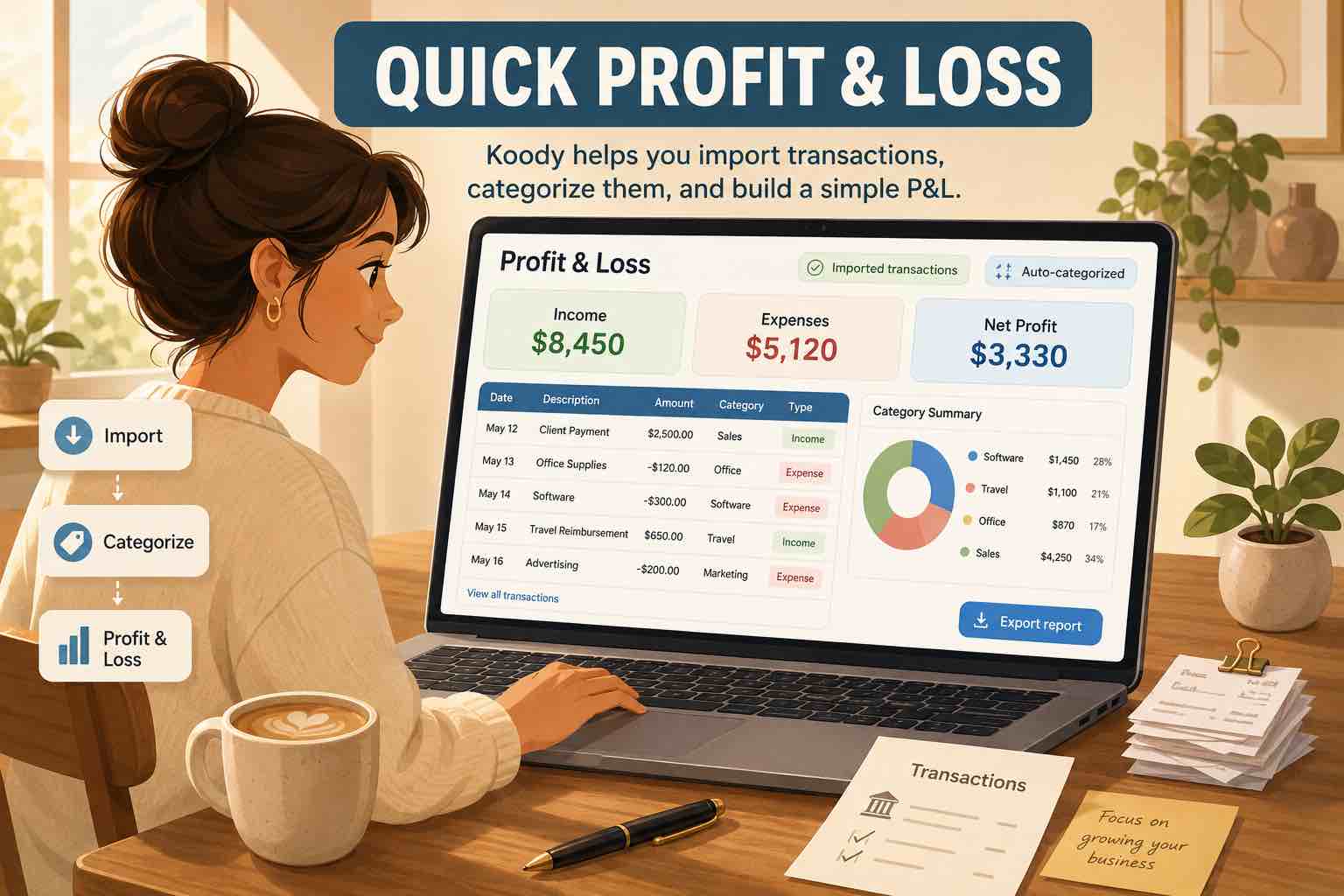
Koody imports bank statements and automatically categorizes transactions, helping you keep up with income and expenses without entering every payment. Split mixed purchases, attach receipts, and use the Business workspace to review profit for the period you choose.
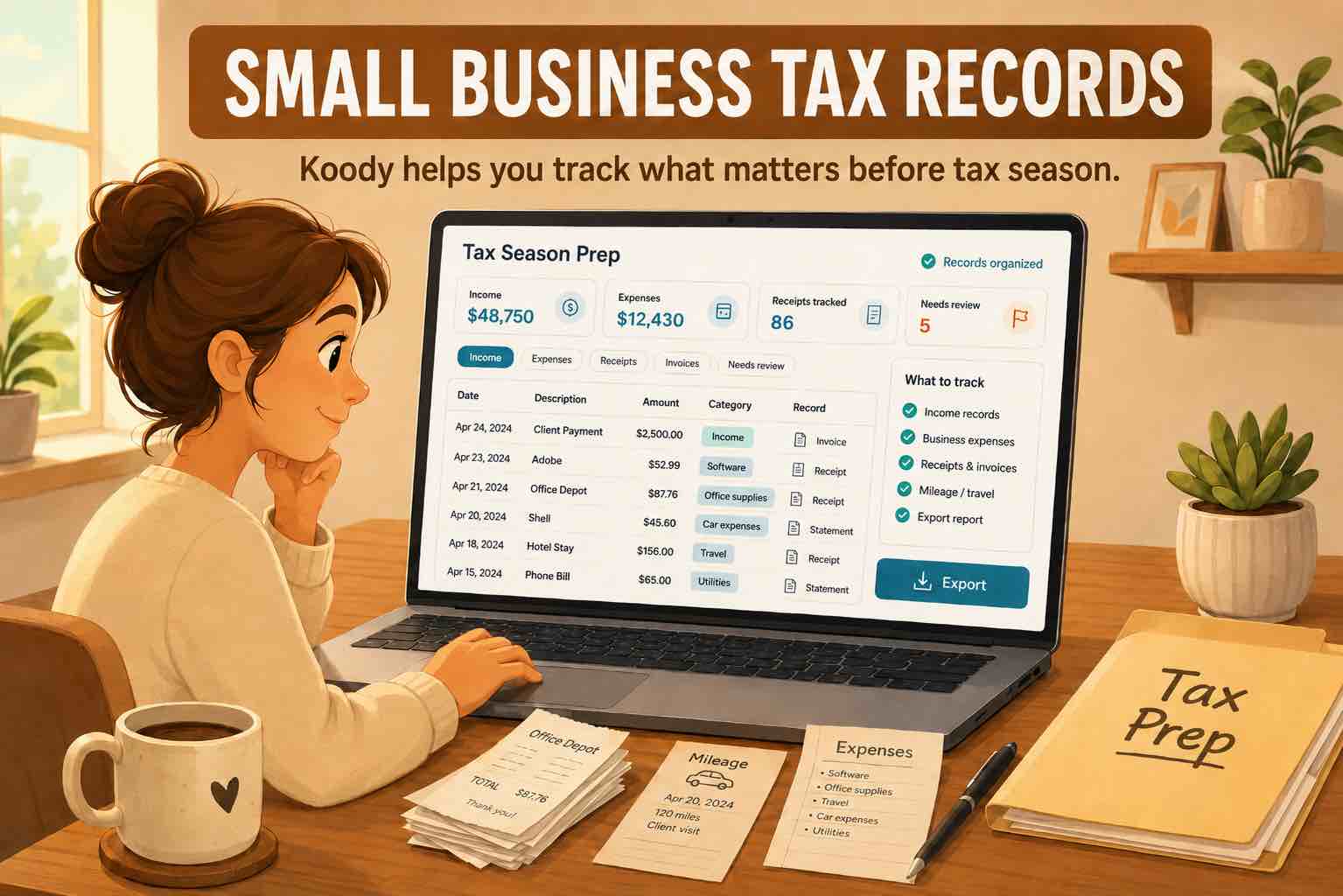
Koody turns your reviewed business records into a profit and loss report and a Schedule C worksheet, ready to download for tax preparation or share with your accountant. Imports, automatic categorization, and business reports are paid features.
Prepare your business reportsSources
Sources accessed November 3, 2026.