Taxes and licenses can be a confusing part of Schedule C because the words sound broad. A sole proprietor may pay for a city business license, a professional renewal, a permit, sales tax, payroll taxes, quarterly estimated taxes, or a tax bill from the IRS. Those records do not all belong in the same bucket.
This guide explains what to separate before tax prep so your accountant or tax preparer can review the right records without guessing.
Important: Koody is a budgeting and record-prep app, not a tax filing service, tax advisor, accountant, tax preparer, payroll provider, or law firm. Use Koody to organize transactions, categories, receipts, files, notes, splits, imports, and exports. A qualified professional should decide final tax treatment.
What Schedule C line 23 is for
What are taxes and licenses on Schedule C?
Schedule C has a line for taxes and licenses. In plain English, this is where certain business taxes, license fees, and regulatory fees may be reviewed.
Think of a barber renewing a local business license, a therapist renewing a professional license, a seller paying a permit fee, or a shop owner paying business property tax on business equipment. Those payments are different from buying shampoo, paying rent, hiring a contractor, or sending a quarterly estimated tax payment to the IRS.
The job before tax prep is to label the payment clearly and keep the receipt or notice close to the transaction.
What can belong in taxes and licenses
What goes on Schedule C line 23?
The IRS Schedule C instructions list several types of records that may be reviewed with taxes and licenses.
- Business licenses and regulatory fees: city business licenses, professional license renewals, local permit fees, and similar payments connected to your trade or business.
- Business property taxes: real estate taxes or personal property taxes on business assets.
- Certain sales taxes: state and local sales taxes imposed on you as the seller, depending on how the money was recorded.
- Some payroll tax records: employer taxes connected to employees, such as the employer share of Social Security and Medicare, FUTA, or state unemployment taxes.
- Other trade or business taxes: state or local business taxes that are connected to running the business.
For example, a solo lawyer may track a state bar renewal, a salon owner may track a cosmetology or shop license, a cleaning business may track local registration fees, and a seller may track a sales tax permit fee. The label should help someone understand what the payment was for.
| Payment | Practical category to review | Helpful note |
|---|---|---|
| City business license renewal | Taxes & Licenses | License period and city or county. |
| Professional license renewal | Taxes & Licenses | Profession, license year, and business use. |
| Business property tax on equipment | Taxes & Licenses | Asset covered by the tax bill. |
| Employer unemployment tax payment | Payroll Taxes / Taxes & Licenses review | Period covered and payroll report. |
| Quarterly federal estimated tax payment | Estimated Tax Payment / Owner Tax Payment | Keep separate from Schedule C expenses. |
What to keep separate
The safest habit is to keep unlike payments apart. A tax payment is not automatically a Schedule C business expense just because it has the word "tax" in it.
Keep these separate for review:
- Federal income tax payments.
- Self-employment tax payments.
- Quarterly estimated tax payments.
- State personal income tax payments.
- Sales tax collected from customers and remitted to a state.
- Sales tax paid as part of buying business property.
- Home or personal property taxes that are not business records.
- License fees or taxes unrelated to the business.
The point is simple: the receipt, payee, amount, and note should tell the reviewer what happened.
Keep tax and license receipts with the transaction.
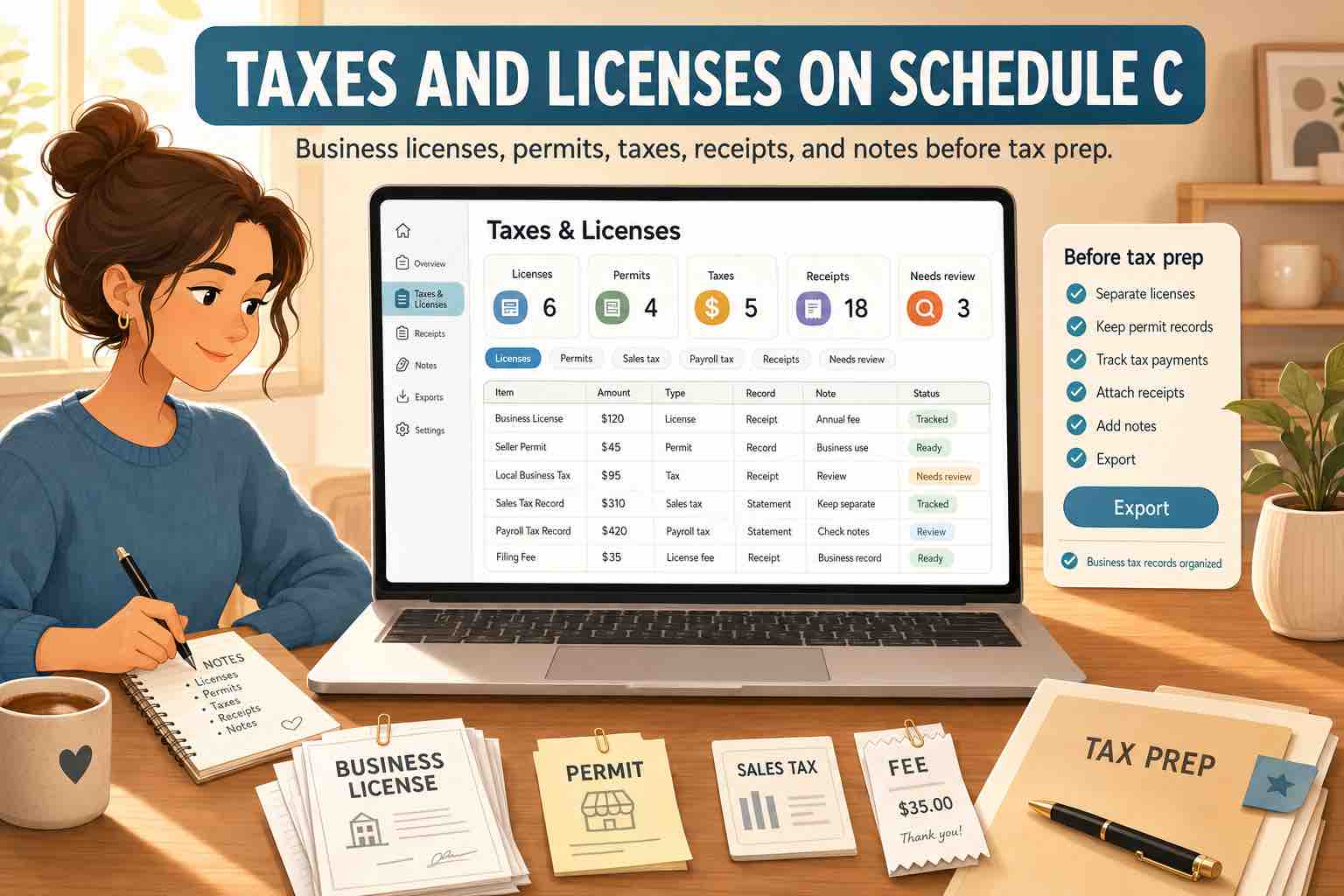
Koody lets you attach license renewals, permit receipts, agency notices, screenshots, PDFs, and notes to the matching row so the payment is easier to explain later.
Track taxes and licenses in KoodyEstimated tax payments
Are estimated tax payments business expenses?
No. Federal income tax payments and self-employment tax payments are personal tax payments. They should not be mixed with rent, supplies, software, meals, professional fees, or license renewals.
If you make quarterly estimated tax payments with Form 1040-ES, keep the payment date, amount, agency, confirmation number, and tax year. In Koody, you can keep those payments separate from normal business categories so they do not inflate Schedule C expenses.
For a deeper guide, read quarterly estimated taxes for sole proprietors.
Sales tax
Is sales tax a business expense on Schedule C?
Sales tax needs careful records because it can show up in more than one way.
- You may collect sales tax from customers and remit it to a state.
- A marketplace may collect and remit sales tax before you receive a payout.
- You may pay sales tax when buying equipment, supplies, or inventory.
- A state or local sales tax may be imposed on you as the seller.
Those situations can be treated differently. Keep sales tax collected from customers separate from ordinary business income where possible. Keep purchase receipts that show sales tax paid on supplies, equipment, or inventory. Keep platform reports if a marketplace collected tax for you.
If you sell through Etsy, eBay, Shopify, Stripe, Square, PayPal, or another platform, your payout may already combine sales, fees, refunds, tax, and transfers. Read 1099-K and marketplace income for more on keeping those pieces separate.
Records to keep for taxes and licenses
What records should I keep for taxes and licenses?
Keep enough detail for someone to understand the payment months later.
- Date paid.
- Agency, state, city, county, platform, or payee.
- Amount paid.
- License, permit, tax, or fee description.
- Period covered, such as the license year or tax quarter.
- Receipt, invoice, renewal notice, bill, statement, or payment confirmation.
- Confirmation number when available.
- Business purpose note.
- Category used in Koody.
Example note: "2026 city business license renewal for hair studio." Another useful note: "Q2 federal estimated tax payment, keep separate from Schedule C expenses."
How Koody helps before tax prep
Koody helps you put the payment and the explanation in the same place.
- Import bank and card transactions.
- Let Koody auto-categorize rows, then review tax, license, permit, and payment rows.
- Use categories like Taxes & Licenses, Estimated Tax Payment, Sales Tax Payable, Payroll Taxes, Professional Licenses, and Business Permits.
- Attach receipts, renewal notices, permit PDFs, agency confirmations, and screenshots.
- Add notes for the period covered, business purpose, license number, or tax year.
- Split mixed payments when only part belongs with business records.
- Export records for accountant or tax-prep review.
Koody does not decide whether a payment belongs on Schedule C line 23. It helps you keep the records organized so the review is easier.
Import, review, attach notes, and export before tax prep.
Bring transactions into Koody, review tax and license rows, attach receipts and confirmations, add useful notes, and export cleaner records when tax prep starts.
Get tax records ready in KoodyFAQs
1. What are taxes and licenses on Schedule C?
Taxes and licenses on Schedule C are business-related taxes, license fees, and regulatory fees that may belong on line 23 after review. Examples can include city business licenses, professional license renewals, permit fees, business property taxes, and some payroll tax records.
2. What goes on Schedule C line 23?
Schedule C line 23 can include certain state and local sales taxes imposed on you as the seller, real estate and personal property taxes on business assets, license and regulatory fees for your trade or business, and some employment tax records. The final treatment depends on the facts.
3. Can I deduct a business license fee?
A yearly license or regulatory fee connected to your trade or business is often reviewed with taxes and licenses. Some licenses that last longer or create a longer-term right may need different treatment, so keep the receipt and renewal details for tax prep.
4. Are quarterly estimated tax payments a Schedule C expense?
No. Federal income tax payments and self-employment tax payments are personal tax payments, not ordinary Schedule C business expenses. Keep estimated tax payments separate from business licenses, permits, fees, supplies, rent, and other business costs.
5. Is sales tax a business expense on Schedule C?
Sales tax needs careful review. The answer can depend on whether the tax was imposed on you as the seller, collected from customers, included in gross receipts, remitted to a state, or paid as part of buying business property.
6. What records should I keep for taxes and licenses?
Keep the date, agency or payee, amount, license or permit period, business purpose, receipt, renewal notice, confirmation number, bill, statement, and any note that explains what the payment covered.
7. How does Koody help with taxes and licenses?
Koody helps you categorize tax and license payments, keep estimated tax payments separate, attach receipts and notices, add notes, split mixed transactions, and export records for accountant or tax-prep review.
Sources: IRS references used
Sources accessed July 5, 2026. Koody is not a tax filing service or tax advisor.